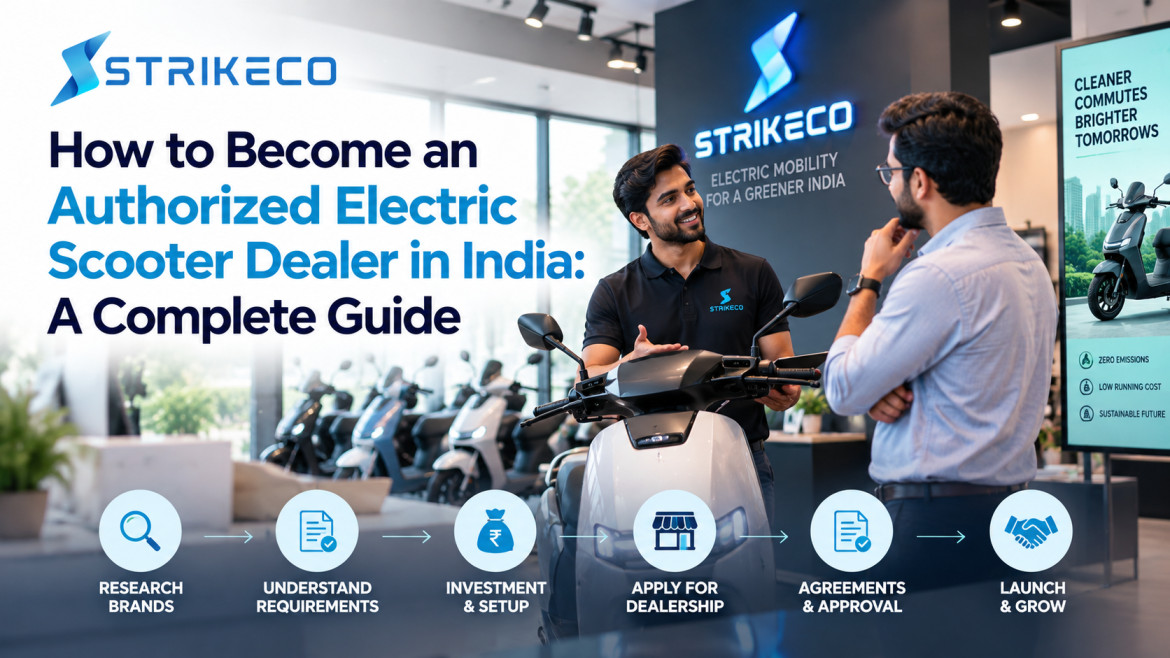
India's electric vehicle market is creating business opportunities for entrepreneurs interested in the automobile and mobility sectors. As more consumers explore electric scooters for daily commuting, businesses can consider entering the market through retail dealerships, multi-brand showrooms, or regional distribution networks.
However, becoming an electric scooter dealer involves more than opening a showroom and displaying vehicles. Entrepreneurs need to select a suitable manufacturer, understand the dealership agreement, estimate their investment, choose a location, manage inventory, and establish a reliable customer service process.
The right approach depends on the entrepreneur's budget, existing business experience, local demand, and long-term goals. Someone who already operates an automobile showroom may prefer adding electric scooters to the existing business, while a new entrepreneur may consider a dedicated dealership.
For businesses exploring these opportunities, Strikeco EV's dealership programme provides information about its exclusive dealership, multi-brand dealership, and distributorship models.
This guide explains the essential steps to become an authorized electric scooter dealer in India and the factors to evaluate before investing.
1. Understand the Electric Scooter Dealership Business
An electric scooter dealership generally involves selling vehicles manufactured or supplied by an EV company to retail customers. Depending on the agreement, the dealer may also handle product demonstrations, bookings, deliveries, warranty coordination, spare parts, and customer support.
The business model can vary considerably between manufacturers.
Some companies work with exclusive dealerships that focus on a single brand. Others allow existing retailers to sell their vehicles alongside products from other manufacturers. Distribution arrangements may focus on supplying vehicles to multiple dealers across a region.
Before choosing a model, understand the responsibilities associated with each option.
Why entrepreneurs consider EV dealerships
Growing consumer interest in electric mobility.
Opportunities to serve local commuters and businesses.
Potential to expand an existing automobile retail operation.
Opportunities to sell related products and spare parts where authorised.
Possibility of building a long-term presence in a developing market.
However, market growth does not guarantee profitability. Sales depend on local demand, product suitability, pricing, competition, financing availability, and after-sales support.
A dealership should therefore be treated as a business investment requiring proper research and financial planning.
2. Choose the Right Dealership Model
One of the first decisions is whether to operate a dedicated showroom, add EV products to an existing business, or become a distributor.
Strikeco lists three dealership formats on its official dealership page. The published requirements below are based on the information available on that page and should be reconfirmed before making an investment.
Option 1: Exclusive electric scooter dealership
An exclusive dealership focuses on one brand and provides a dedicated showroom experience.
According to Strikeco's published dealership information, its exclusive model specifies:
Initial order: 12 vehicles.
Showroom space: approximately 1,000–1,500 sq. ft.
Reorder quantity: 36–40 units.
Showroom design support: digital design support.
Security deposit: not required, according to the published terms.
The dealer remains responsible for showroom execution and offline marketing activities as outlined in the programme.
This option may suit entrepreneurs who want to establish a dedicated EV retail business and can invest in a suitable commercial location, inventory, staff, and operating expenses.
Option 2: Multi-brand EV dealership
A multi-brand EV dealership allows an existing retailer to add another electric vehicle brand to its product range.
Strikeco's published requirements for this model include:
Initial order: 12 vehicles.
Space: shared showroom space.
Reorder quantity: 12–24 units.
Branding support: display guidelines and branding support.
Security deposit: not required, according to the published terms.
This model may be suitable for existing automobile dealers, two-wheeler retailers, and entrepreneurs who already have a showroom and want to expand into electric mobility.
The main advantage is that the business may be able to use existing premises and operational resources. However, the owner should assess showroom capacity, brand presentation requirements, inventory commitments, and the additional working capital needed.
Option 3: Distributorship
A distributorship generally involves supplying vehicles to dealers or retail partners across a defined region rather than concentrating exclusively on direct retail sales.
Strikeco's published distributorship model specifies an initial order of 40–80 vehicles, with warehouse or godown space required. Reorder quantities are determined by mutual agreement.
This option may suit established automotive businesses or entrepreneurs with experience in inventory management, logistics, and dealer relationships.
Because a distribution operation can require more working capital and storage capacity, entrepreneurs should assess the expected demand and cash-flow cycle carefully.
3. Estimate the Investment Required
The investment needed to open an electric scooter dealership depends on the dealership model, location, showroom size, inventory, staffing, and working capital.
There is no single investment amount suitable for every dealer.
Instead of relying on a general franchise-cost estimate, prepare a detailed budget based on the manufacturer's current commercial terms.
Major cost components
Initial vehicle inventory: Calculate the cost of the required opening stock and understand whether the manufacturer requires full payment before dispatch.
Showroom rental and deposit: Include rent, security deposit, electrical work, flooring, signage, lighting, and display arrangements.
Staffing: Budget for sales staff, administrative support, and any service personnel required by the dealership agreement.
Marketing: Account for local promotions, launch events, digital advertising, brochures, and other customer acquisition activities.
Operating expenses: Include electricity, internet, insurance, software, transport, utilities, and ongoing maintenance.
Working capital: Keep funds available for regular expenses, inventory replenishment, and periods when sales are slower than expected.
Strikeco's published dealership terms state that full payment is required before dispatch unless otherwise agreed in writing. Entrepreneurs should confirm the current payment terms, inventory costs, applicable taxes, and delivery arrangements before placing an order.
A useful rule is to separate the initial setup budget from the working capital needed to operate the dealership after launch.
4. Select the Right Location for Your Showroom
Location can influence customer visibility, walk-in enquiries, accessibility, and operating costs.
A showroom near a busy road may attract attention, but higher rent does not automatically translate into higher sales. Entrepreneurs should evaluate the local customer base and competition before signing a lease.
What to look for
Easy road access and convenient parking.
Visibility from nearby residential or commercial areas.
Sufficient space to display vehicles safely.
Room for customer demonstrations and discussions.
Suitable electrical facilities and safe charging arrangements.
Access to transport routes and delivery facilities.
Proximity to the customers you intend to serve.
If you are considering a dealership in Madhya Pradesh, research demand in your target city and surrounding areas. For example, an entrepreneur exploring electric scooter manufacturers in Indore should evaluate the local competition, customer preferences, and service requirements before committing to a location.
For a dedicated showroom, confirm the manufacturer's space and branding requirements in writing. For a multi-brand dealership, establish how much shared space is needed to display vehicles properly.
5. Research the Manufacturer Before Applying
Selecting the right manufacturer is one of the most important parts of the dealership process.
A low initial investment may look attractive, but it is not enough to establish whether a dealership is commercially viable. Product quality, customer demand, spare-parts availability, warranty support, pricing, and dealer communication can all affect the business.
Questions to ask a potential manufacturer
Product range: What models and variants are available? Which customer groups are they designed for?
Commercial terms: What is the initial order requirement, wholesale pricing, and reorder quantity?
Dealer margins: How are margins calculated? Are incentives, targets, or other conditions applicable?
Warranty and service: Who handles warranty claims, repairs, and technical support?
Spare parts: Which parts are available, how are they ordered, and what are the expected delivery timelines?
Territory: Is the dealer granted an exclusive area? If so, how is that territory defined?
Marketing: What support is provided for branding, promotional material, and local campaigns?
Payment and delivery: What are the payment terms, dispatch process, and expected delivery timelines?
Entrepreneurs considering Strikeco EV can review its published dealership models and contact the company to clarify the latest terms before proceeding.
6. Complete the Business Registration and Documentation
Once the dealership model and manufacturer have been shortlisted, prepare the documentation required to establish and operate the business.
The exact requirements depend on the business structure, state, premises, and dealership activities.
Common documents and registrations to consider
PAN and identity documentation for the proprietor or authorised representatives.
Business constitution documents, where applicable.
Business bank account and financial details.
Commercial premises ownership or rental documentation.
GST registration where required by law.
Applicable local trade permissions and establishment registrations.
Dealer agreement and manufacturer authorisation documents.
Insurance and other documentation relevant to the business.
The official GST registration guidance explains the registration process and documentation for eligible applicants.
Do not assume that the same licences apply to every dealership. Confirm the applicable requirements with a qualified accountant or local professional, particularly if you plan to operate a workshop, handle vehicle registration-related processes, or provide additional services.
Before accepting customer bookings, clarify invoicing, payment collection, delivery documentation, warranty procedures, and the responsibilities assigned to the dealer under the agreement.
7. Set Up Inventory, Sales, and After-Sales Support
A dealership's reputation depends on more than the vehicles displayed in its showroom. Customers also want accurate product information, transparent pricing, reliable delivery, and clear support when something goes wrong.
Organise inventory carefully
Begin with the models and quantities recommended for your dealership type. Avoid placing large additional orders before understanding local demand.
Track inventory by model, variant, purchase cost, arrival date, and sale status. Maintain a reorder process that considers both sales velocity and the manufacturer's lead times.
Train the sales team
Sales staff should understand vehicle specifications, charging requirements, range limitations, warranty conditions, safety instructions, and the differences between models.
They should avoid promising performance figures or savings that cannot be supported by the manufacturer's information.
Establish service and warranty procedures
Confirm how customers should report faults, how warranty claims are processed, and which repairs can be handled locally. Train relevant staff to follow manufacturer instructions and refer specialised work to authorised personnel where required.
A clear process for handling complaints, spare-parts requests, and follow-ups helps build customer confidence.
8. Build a Local Marketing Strategy
Opening the showroom is only the beginning. The dealership needs a plan to attract potential buyers and convert enquiries into sales.
Use local digital marketing
Create a business profile with accurate location details, opening hours, contact information, and genuine customer reviews. Build a website or landing page that explains the available models, key specifications, dealership location, and enquiry process.
Search campaigns and local SEO can help connect the dealership with people actively researching electric scooters in the area.
Demonstrate the products
Where permitted and supported by the manufacturer, arrange test rides and product demonstrations. Customers may want to understand handling, seating comfort, storage, charging, and practical range before making a decision.
Develop local partnerships
Depending on the target market, explore opportunities to connect with local businesses, housing communities, delivery operators, and other potential customer groups.
All promotional claims should be accurate. If you advertise a discount, warranty, financing offer, or government incentive, verify the current conditions before publishing the information.
9. Understand Dealer Profitability and Cash Flow
A dealership can generate sales and still experience cash-flow problems if inventory purchases, operating expenses, and customer payments are poorly managed.
Before investing, prepare a basic financial model.
Estimate monthly fixed costs, expected sales volume, gross margin per vehicle, and the working capital required for inventory replenishment.
For example, if your fixed monthly expenses are ₹1,00,000 and your average contribution after variable costs is ₹10,000 per vehicle, you would need to sell 10 vehicles per month to cover those fixed expenses. This is an illustrative calculation, not a forecast of any manufacturer's margins or a guarantee of dealership performance.
Actual profitability depends on purchase price, selling price, discounts, taxes, staff costs, rent, logistics, warranty responsibilities, and the agreement with the manufacturer.
Ask the company for written details of dealer pricing and all commercial conditions before preparing your final business plan.
10. How to Apply for a Strikeco EV Dealership
If you want to explore becoming an authorised dealer, start by reviewing the available partnership options and deciding which one matches your business capacity.
Strikeco's dealership programme describes support relating to branding, marketing materials, operations, and services. The exact scope should be confirmed directly with the company.
A practical application process
Choose your model: Decide whether an exclusive dealership, multi-brand arrangement, or distributorship is appropriate.
Prepare your business profile: Include your location, business experience, available premises, and intended market.
Review the commercial requirements: Confirm initial order quantities, pricing, payment conditions, and reorder expectations.
Discuss the location: Ask whether the proposed territory is available and whether any exclusivity conditions apply.
Review the agreement: Check the responsibilities of both parties, warranty arrangements, marketing obligations, termination conditions, and other contractual terms.
Plan the investment: Finalise the budget for inventory, premises, staffing, marketing, and working capital.
Complete the formalities: Submit the requested documents and obtain written confirmation of the dealership arrangement.
Prepare for launch: Set up the showroom, train staff, organise inventory, and plan local promotions.
Start your enquiry through the official Strikeco dealership page. Confirm the current terms and obtain written approval before presenting yourself as an authorised dealer.
Frequently Asked Questions
1. How can I become an authorized electric scooter dealer in India?
Research manufacturers, choose a dealership model, prepare a business plan, confirm investment and inventory requirements, complete the required registrations, and sign a formal dealership agreement. The process and requirements vary by manufacturer and location.
2. How much investment is required to open an electric scooter dealership?
The investment depends on the manufacturer, initial inventory, showroom requirements, location, and operating expenses. Obtain current pricing and commercial terms from the company before estimating the total investment.
3. Can I sell electric scooters alongside other vehicle brands?
Some manufacturers offer multi-brand dealership arrangements. Check whether the company permits this model and confirm the space, branding, inventory, and contractual requirements.
4. What documents are needed to start an EV dealership?
Common requirements may include identity and PAN documents, business registration documents where applicable, premises documentation, tax registrations where required, and the manufacturer's dealership agreement. Additional permissions may depend on the state and business activities.
5. Does Strikeco offer different dealership options?
Strikeco's published dealership page lists exclusive dealership, multi-brand dealership, and distributorship options. Confirm current availability, order quantities, space requirements, and commercial terms directly with the company.
6. How can an electric scooter dealer attract customers?
Local SEO, accurate business listings, product demonstrations, test rides where available, transparent pricing, community outreach, and reliable after-sales service can help generate enquiries and build customer trust.
Becoming an authorized electric scooter dealer in India can be an opportunity for entrepreneurs who understand their local market and are prepared to build a reliable retail operation. Success depends on selecting the right manufacturer, choosing an appropriate dealership model, managing inventory carefully, and providing customers with accurate product information and dependable support.
Before investing, review the manufacturer's commercial terms, calculate the complete setup and operating costs, check the relevant legal requirements, and prepare a realistic sales forecast.
For entrepreneurs interested in entering the EV market, Strikeco offers published options for exclusive dealerships, multi-brand retail partnerships, and distributorships. Reviewing these options and discussing the latest requirements directly with the company is a practical first step.
A well-planned dealership should focus not only on selling vehicles but also on building customer confidence, maintaining service standards, and managing the business sustainably over the long term.