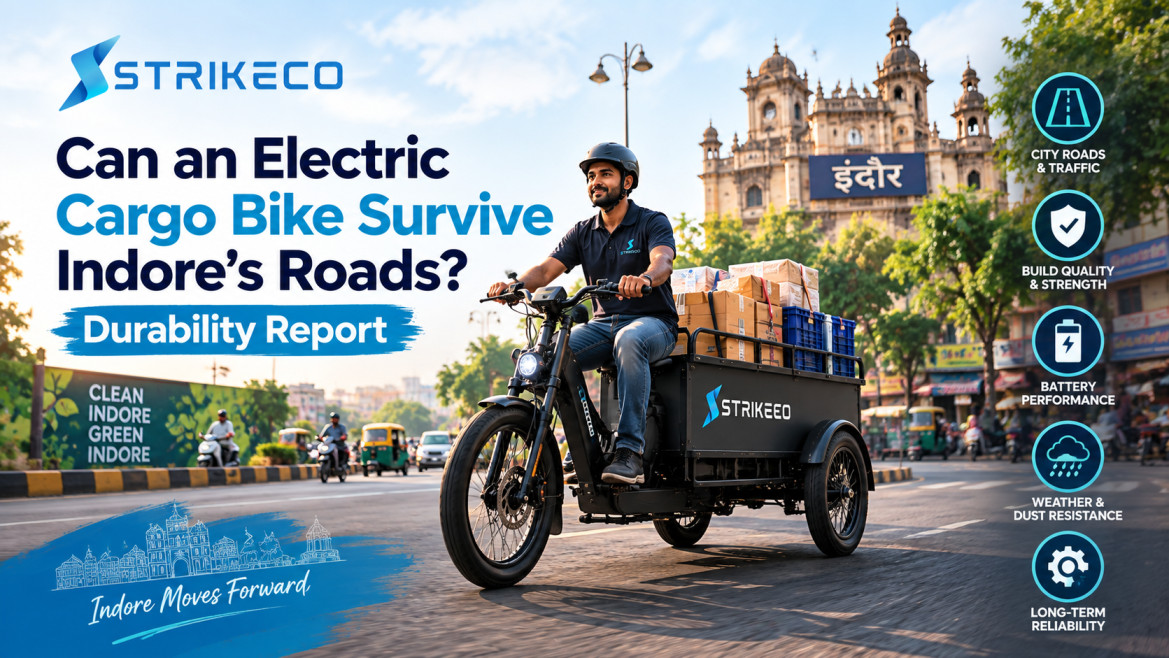
Indore's growing commercial activity creates demand for reliable vehicles that can transport goods across residential areas, markets, warehouses, and business districts. For delivery operators, retailers, waste management teams, and small businesses, choosing the right commercial vehicle can directly affect daily productivity and operating costs.
Electric cargo vehicles are becoming an option worth considering because they can offer lower energy costs and quieter operation than conventional fuel-powered alternatives. However, one important question remains: can an electric cargo bike withstand the road conditions encountered during everyday operations in Indore?
Potholes, uneven surfaces, speed breakers, waterlogged streets, frequent stops, and heavy cargo can put considerable stress on a vehicle's tyres, suspension, chassis, brakes, and electrical components. A vehicle that performs well on smooth roads may require more maintenance when used continuously on difficult routes.
This durability report examines the practical factors that determine whether an electric cargo vehicle is suitable for Indore's roads. It also reviews the published specifications of Strikeco's Zordaar and Garbot utility vehicles to help businesses understand what to inspect before purchasing.
Important note: This is a specification-based durability assessment, not a physical road test. No independently measured endurance results or long-term field-test data were available for this article. Actual performance must be verified through inspection, a suitable demonstration, and operating experience.
1. What Makes Indore's Roads Challenging for Cargo Vehicles?
Road conditions can vary considerably across a city. A vehicle may spend part of its day travelling on well-maintained main roads and the rest navigating narrow streets, construction diversions, market lanes, or uneven service roads.
Reports published during 2025 highlighted potholes, road damage, and waterlogging concerns in parts of Indore. In June 2025, The Times of India also reported on municipal preparations to repair pothole-affected roads and address waterlogging before the monsoon.
External reference: Indore's pre-monsoon road repair preparations — The Times of India
These reports provide context about potential operating conditions; they do not establish that every road in Indore is damaged or that a particular vehicle has been tested on those roads.
Common road-related challenges
Potholes and broken surfaces: Repeated impacts can stress tyres, rims, suspension components, steering systems, and structural joints.
Speed breakers: Poorly approached speed breakers can cause underbody impacts, especially when a vehicle carries a heavy load or has limited ground clearance.
Uneven and unpaved roads: Loose gravel, broken edges, and irregular surfaces can affect traction, braking, and stability.
Monsoon waterlogging: Standing water can conceal potholes and increase the risk of electrical damage, corrosion, and loss of traction.
Stop-and-go traffic: Frequent braking, acceleration, and manoeuvring can increase wear and put additional demands on the motor and electrical system.
For a commercial vehicle making repeated deliveries throughout the day, these conditions make durability a critical purchasing consideration.
2. The First Durability Check: Chassis and Load Capacity
The chassis and cargo structure form the foundation of an electric cargo vehicle. They support the vehicle's weight, the battery, the motor, the rider, and the goods being transported.
When a loaded vehicle travels over a pothole or uneven road, the impact forces can be greater than those experienced during unloaded travel.
What should buyers inspect?
Frame construction and visible weld quality.
Cargo platform strength and mounting points.
Fasteners, joints, and structural supports.
Ground clearance when the vehicle is loaded.
Maximum permitted payload and gross vehicle weight.
Manufacturer guidance on load distribution.
Strikeco's Zordaar electric cargo vehicle is listed with a maximum load capacity of 380 kg. The product page also specifies a shock-up strength of 500 kg.
These figures are useful starting points for evaluating the vehicle's intended utility, but they should not be interpreted as proof that it can withstand repeated pothole impacts or carry any load under all conditions.
Ask the manufacturer what the shock-up specification represents, how the load capacity is defined, and whether any operating restrictions apply.
Why load distribution matters
Even when the cargo remains below the stated payload limit, poor weight distribution can affect stability and component stress.
Heavy items should be secured and positioned according to the manufacturer's loading instructions. Avoid placing too much weight on one side or allowing cargo to shift during braking and turning.
Durability verdict: A clearly specified load capacity is useful, but real-world suitability depends on the frame design, suspension, permitted gross weight, and how the vehicle is loaded and operated.
3. Suspension: The First Line of Defence Against Uneven Roads
Suspension helps absorb road impacts and maintain tyre contact with the surface. For cargo vehicles, it also contributes to load stability and protects components from unnecessary shock.
If a vehicle frequently travels over potholes and speed breakers, its suspension deserves particular attention.
What to look for
Impact absorption: Does the suspension cope with uneven surfaces without frequent harsh bottoming-out?
Loaded performance: Does the vehicle remain stable when carrying a typical commercial load?
Component durability: Are suspension mounts, bushings, springs, and related parts accessible for inspection and replacement?
Ground clearance: Is there enough clearance to reduce the risk of underbody contact on the intended routes?
Strikeco lists a 500 kg shock-up strength specification for Zordaar. However, this specification alone does not establish suspension travel, ride comfort, damping performance, or long-term durability.
Before purchasing, arrange a demonstration over representative road surfaces and ask the manufacturer to explain the suspension specification.
Avoid deliberately hitting potholes at speed during a test ride. A safe evaluation should use controlled conditions and normal operating speeds.
Durability verdict: Suspension quality is essential for rough-road cargo operations, but buyers need more detailed specifications and a practical demonstration to assess actual performance.
4. Tyres and Braking: Critical for Daily Commercial Use
Tyres and brakes are among the most important safety components on a cargo vehicle.
Uneven surfaces can reduce tyre contact with the road, while potholes can damage sidewalls or rims. Heavy cargo also affects stopping distance and handling.
Strikeco's Zordaar product page lists CEAT tyres with the following specifications:
3.75-12
90/90-12
The manufacturer also lists mechanical drum brakes.
These details help buyers identify the fitted components, but tyre specifications and brand names alone do not establish puncture resistance, wet-road grip, or braking performance under maximum load.
What to check before purchase
Tyre load and speed ratings.
Recommended tyre pressure for loaded operation.
Availability and cost of replacement tyres.
Braking performance at permitted operating loads.
Brake adjustment and maintenance requirements.
Stability during controlled braking.
Availability of replacement brake components.
A commercial operator should also create a regular inspection routine. Damaged tyres, incorrect pressure, worn brake components, and loose wheel fasteners should be addressed promptly.
Durability verdict: The listed tyres and braking system provide useful information, but the vehicle should be evaluated under appropriate conditions before being relied on for demanding daily routes.
5. Can the Battery and Electrical System Handle Monsoon Conditions?
An electric cargo vehicle's durability depends not only on its frame and running gear but also on its battery, motor, controller, wiring, and connectors.
Rain and standing water introduce additional risks. Water can enter inadequately protected electrical components, damage connectors, accelerate corrosion, or create safety hazards.
Strikeco lists Zordaar with a 48V, 135Ah battery and an estimated range of 80–100 km per charge. The published charging time is approximately 8–9 hours.
These are manufacturer-listed specifications, not independently verified measurements of battery endurance or weather resistance.
Battery-related checks
Before buying, ask for:
Battery chemistry and manufacturer details.
Battery warranty duration and exclusions.
Available replacement battery pricing.
Charging instructions and recommended operating conditions.
Details of electrical protection and water-resistance ratings.
Guidance on safe operation during heavy rain.
Inspection and maintenance procedures after water exposure.
A battery's voltage and amp-hour rating indicate electrical characteristics, but they do not establish how long it will last under daily commercial use. Battery lifespan depends on chemistry, temperature, charging behaviour, load, usage, and maintenance.
Never assume an electric vehicle is safe to drive through deep water simply because it is designed for outdoor use. Follow the manufacturer's water-depth and operating restrictions, and do not charge a wet or damaged vehicle until it has been inspected as instructed.
Durability verdict: The published battery specifications help establish the vehicle's electrical configuration, but the available information does not independently confirm monsoon resistance or long-term battery performance.
6. What Happens When the Vehicle Carries Heavy Loads Every Day?
A cargo vehicle used for occasional deliveries faces different demands from one that operates throughout the day.
For example, a retailer may transport goods between a warehouse and several shops. A waste collection operator may make frequent stops, travel through narrow lanes, and carry variable loads. A logistics business may need repeated trips across mixed road conditions.
These patterns affect battery consumption, braking wear, tyre life, suspension maintenance, and the time required for charging.
Build a realistic daily operating plan
Start by estimating:
Total kilometres travelled each day.
Number of deliveries or stops.
Average cargo weight and maximum expected load.
Percentage of the route spent on rough or uneven surfaces.
Time available for charging.
Distance to authorised service support.
Then compare those requirements with the vehicle's specifications and the manufacturer's operating recommendations.
For example, a vehicle advertised with an 80–100 km range should not automatically be scheduled for 100 km of daily loaded travel. Cargo weight, road conditions, speed, and operating patterns can reduce the available range.
A sensible plan includes a reserve for detours, unexpected delays, and changing road conditions.
7. Zordaar vs Garbot: Which Strikeco Utility Vehicle Should Businesses Evaluate?
Strikeco lists Zordaar and Garbot among its utility-focused electric vehicles. Both are intended for commercial applications, but their published descriptions highlight different uses.
<text color="secondary" size="sm">Published product specifications; not independent road-test results.</text>
Specification
Zordaar
Garbot
Listed application
Heavy-duty cargo and logistics
Waste collection and urban utility work
Motor
1,000W BLDC with hydraulic assist
1,000W BLDC
Listed range
80–100 km
80–100 km
Maximum load capacity
380 kg
350 kg
Shock-up strength
500 kg
500 kg
Charging time
8–9 hours
Confirm with manufacturer
Tyre information
CEAT tyre specifications listed
Confirm current specification
Sources: Zordaar specifications and Garbot specifications.
When Zordaar may be worth evaluating
Zordaar is worth considering for businesses that need a dedicated cargo vehicle and want to assess its payload, battery capacity, charging time, and suitability for regular goods transport.
When Garbot may be worth evaluating
Garbot is described for waste collection and urban utility applications. Businesses should assess its cargo arrangement, access to service support, permitted load, and suitability for their specific operating routes.
Neither model can be declared more durable on Indore's roads based on these specifications alone. That conclusion would require comparable testing or reliable long-term field data.
8. A Practical Durability Inspection Checklist
Before purchasing an electric cargo vehicle, use the following checklist during a manufacturer demonstration or inspection.
<text color="secondary" size="sm">Mark each item after checking it with the manufacturer or authorised service team.</text>
Inspect the chassis, welds, cargo platform, and mounting points.
Confirm the permitted payload and gross vehicle weight.
Ask how the shock-up or suspension-strength specification is measured.
Check ground clearance under representative loading conditions.
Confirm tyre specifications, load ratings, and replacement availability.
Test braking and steering under controlled, permitted conditions.
Ask about water-resistance ratings and restrictions for wet-road operation.
Confirm battery warranty, replacement price, and expected service support.
Verify the real-world range expected for your route and cargo weight.
Review charging time and electrical requirements.
Ask for the maintenance schedule and spare-parts availability.
Request references or documented fleet experience from similar commercial users, if available.
Confirm service response times and the process for reporting faults.
Check all required registration, insurance, and operating requirements.
This checklist can help identify questions that may not be answered by a product brochure alone.
9. How to Improve the Vehicle's Service Life on Indore's Roads
Even a well-designed commercial vehicle needs appropriate maintenance. Rough roads and frequent heavy-load operation make regular inspections especially important.
Before starting the day
Check tyre pressure, brakes, lights, steering, visible wiring, cargo restraints, and any unusual noises or warning indicators.
After repeated rough-road use
Inspect tyres and rims for damage, check for loose fasteners, and look for visible damage to the suspension, frame, or underbody. Report unusual vibration or changes in handling to the service team.
During the monsoon
Avoid waterlogged sections when possible, especially where the depth and road surface are unknown. Clean and inspect the vehicle according to the manufacturer's instructions, and have electrical or battery components checked if they have been exposed to water beyond the permitted conditions.
Follow the recommended service schedule
Use authorised parts where required and keep records of repairs, battery performance, tyre replacement, and maintenance costs.
For commercial operators, tracking downtime is particularly useful. A vehicle with low energy costs may still become expensive if repeated repairs keep it out of service.
10. Final Durability Assessment: Is an Electric Cargo Vehicle Suitable for Indore?
The answer depends on the specific vehicle, the cargo being carried, and the roads it will travel every day.
A cargo vehicle intended for urban operations needs an appropriate chassis, suspension, tyres, brakes, electrical protection, and service support. Published payload and battery specifications are important starting points, but they cannot independently establish long-term durability.
Strikeco's Zordaar and Garbot provide published specifications that businesses can use to begin their evaluation. Zordaar lists a 380 kg maximum load capacity, 500 kg shock-up strength, and an 80–100 km range. Garbot lists a 350 kg maximum load capacity and the same stated range and shock-up strength.
These claims should be verified with the manufacturer, particularly if the vehicle will carry heavy loads or operate on rough roads throughout the day.
Before making a purchase, request a demonstration that reflects your intended route and operating conditions, confirm the manufacturer's maintenance and warranty terms, and investigate service availability in your area.
Frequently Asked Questions
1. Can an electric cargo vehicle handle potholes?
It depends on its chassis, suspension, tyres, ground clearance, load, and operating speed. No vehicle should be assumed to handle severe potholes safely without suitable design specifications and practical evaluation.
2. Is Zordaar suitable for commercial deliveries in Indore?
Strikeco describes Zordaar as a heavy-duty electric cargo vehicle for logistics and last-mile delivery, with a listed maximum load capacity of 380 kg. Suitability for a specific delivery route should be confirmed through the manufacturer's guidance and a representative demonstration.
3. Does a 500 kg shock-up specification guarantee durability?
No. The meaning and test method behind the specification matter. It should not be interpreted as proof of long-term performance on potholes or as permission to exceed the vehicle's rated payload.
4. Can electric cargo vehicles operate during the monsoon?
Operation depends on the vehicle's electrical protection, permitted water exposure, road conditions, and manufacturer's instructions. Avoid deep or unknown water and follow the specified safety and maintenance procedures.
5. How can businesses reduce maintenance costs?
Use the vehicle within its rated limits, secure cargo correctly, maintain tyre pressure, inspect brakes and suspension, follow the service schedule, and address unusual noises or handling changes promptly.
6. What should a business check before buying an electric cargo vehicle?
Prioritise payload, chassis and suspension specifications, braking, tyres, practical range under load, charging arrangements, battery warranty, spare-parts availability, and authorised service support.
Indore's mixed road conditions make durability an important consideration for businesses evaluating electric cargo vehicles. Potholes, uneven surfaces, monsoon waterlogging, and frequent heavy-load operations can affect vehicle performance, safety, and maintenance costs.
The most useful way to assess an electric cargo vehicle is to combine manufacturer specifications with a careful inspection, a representative demonstration, and clear information about warranty and service support.
Strikeco's Zordaar and Garbot are two utility-focused models worth evaluating for commercial applications. Their published specifications provide a starting point, but an independent road test or documented fleet experience would be needed to establish how they perform over time on Indore's roads.
For businesses planning daily cargo operations, the final decision should be based on the actual route, load requirements, practical range, maintenance arrangements, and total operating cost—not specifications alone.