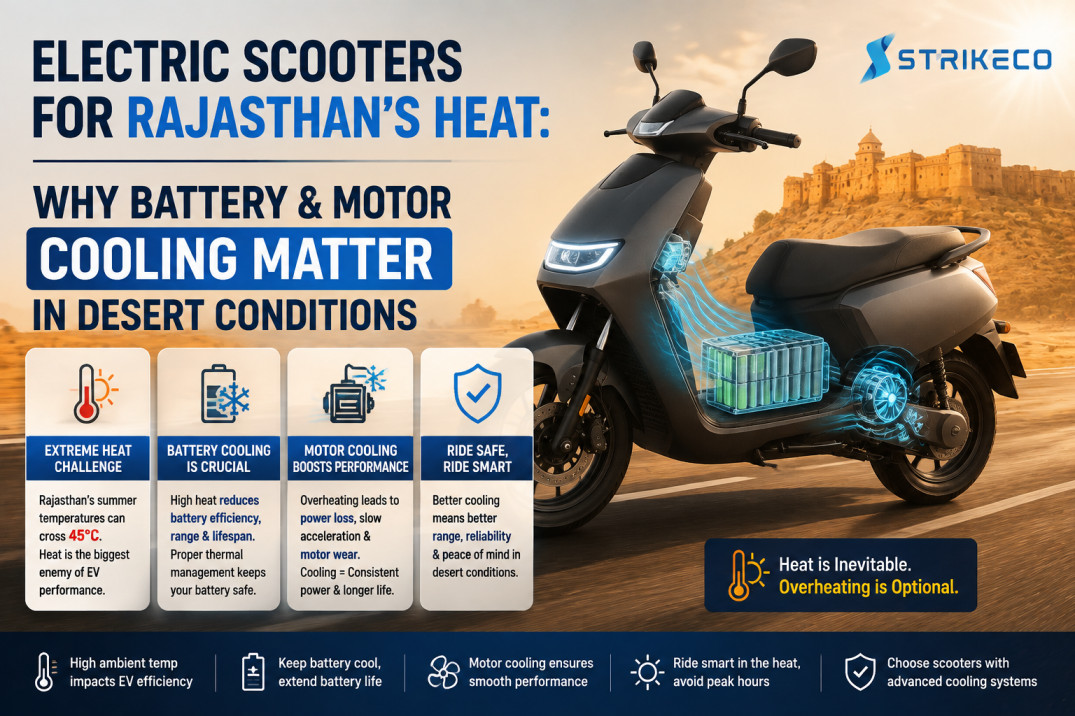
Rajasthan doesn't have ordinary Indian summers — it has some of the harshest heat in the country. Cities like Bikaner, Churu, Jaisalmer, and Jodhpur routinely cross 45°C between April and June, with road surface temperatures running significantly higher than ambient air. That's a demanding environment for any vehicle, but it's a particularly important factor for electric scooters, where heat directly affects two of the most expensive components on the vehicle: the battery and the motor.
If you're evaluating an electric scooter for daily use in Rajasthan, heat tolerance deserves the same attention as range and price — arguably more, because it determines how well those range and price numbers hold up two summers from now.
Why Heat Is a Bigger Deal for EVs Than Petrol Scooters
A petrol scooter's engine is designed to run hot — that's simply how internal combustion works. An electric scooter's battery and motor are the opposite: they perform best within a specific temperature range, and both efficiency and long-term lifespan drop off outside that window.
Two components are affected most:
1. The battery
Whether lithium-ion or lead-acid, batteries rely on internal chemical reactions that are temperature-sensitive. In high heat:
Internal resistance increases, which reduces how efficiently the battery delivers power
Charge acceptance changes, meaning a battery may take a full charge less efficiently in extreme heat
Long-term capacity degrades faster — a battery regularly exposed to 45°C+ conditions will typically show a shorter usable lifespan than the same battery used in a milder climate
Range on a given day can measurably drop compared to the same scooter, same rider, same route, on a cooler day
This is one of the reasons range figures quoted by any electric scooter manufacturer in India are tested under standard lab conditions — real desert-summer riding is a genuinely tougher test than the certification cycle.
2. The motor
Electric motors generate heat under load, and that heat has to go somewhere. In cooler climates, ambient airflow alone often does enough of the job. In Rajasthan's summer, when ambient temperature is already near or above the motor's ideal operating range, that natural heat dissipation is far less effective. Sustained heavy load — climbing an overpass, carrying a pillion, stop-start traffic in peak afternoon heat — pushes motor temperatures higher for longer, which over time can accelerate wear on internal components.
What to Actually Check Before Buying
Given Rajasthan's climate, these are the questions worth asking any manufacturer or dealer — StrikeCo included — before purchase:
What's the battery's rated operating temperature range? Ask specifically, not just for the general spec sheet.
Is there any thermal protection built in — such as controllers that reduce power output automatically if temperatures exceed safe limits, rather than risking component damage?
What's the battery warranty, and does it account for high-heat regions, or is it a blanket national policy that doesn't reflect Rajasthan's specific conditions?
How is the scooter typically stored and charged — charging a battery immediately after a hot ride, or leaving a scooter parked in direct sun for hours, both add avoidable thermal stress regardless of how well-engineered the vehicle is.
Riding and Charging Habits That Matter As Much As the Scooter Itself
Even a well-built electric scooter will perform better with heat-conscious habits, especially during Rajasthan's peak summer months:
Avoid charging immediately after a long, hot ride. Letting the battery cool for 20-30 minutes before plugging in reduces combined thermal stress from riding heat and charging heat.
Park in shade wherever possible, particularly during peak afternoon hours (12 PM-4 PM), rather than leaving the scooter in direct sun for extended periods.
Avoid charging in direct, enclosed sunlight — a parked scooter in a closed, sun-exposed space can reach much higher internal temperatures than the ambient air temperature suggests.
Keep tyres at the correct pressure. Under-inflated tyres increase rolling resistance, which increases motor load and heat generation for the same distance travelled.
How StrikeCo Approaches This
As an electric scooter manufacturer in India, we design and test our vehicles knowing they'll be ridden across genuinely diverse Indian conditions — not just moderate-climate cities. That means being transparent with buyers and dealers, especially in high-heat regions like Rajasthan, about a few things:
We disclose battery and motor specifications clearly so buyers and dealers can evaluate suitability for local conditions rather than relying on a single blanket range figure.
We're expanding our dealer network into Rajasthan specifically to make sure buyers there have local service and support access — heat-related battery servicing needs are different from what a cooler-climate dealer typically handles, and proximity to service matters more in extreme-climate regions.
We encourage every buyer, regardless of state, to ask about real-world performance in their specific climate rather than assuming a national average range applies uniformly.
Our Eco Sprint — StrikeCo's entry-level commuter model — is built for exactly the kind of daily city riding common across Rajasthan's towns and cities: moderate daily distances, home charging overnight, and a straightforward ownership experience. If you're considering it for use in a high-heat region, we'd recommend the same approach outlined above — ask your local dealer about battery warranty terms and heat-conscious charging guidance specific to your city, rather than assuming national specs apply unchanged in Jaisalmer or Bikaner conditions.
Heat isn't a dealbreaker for electric scooters in Rajasthan — millions of EVs operate reliably in hot climates worldwide — but it is a factor that deserves honest attention before purchase, not after your battery underperforms in its second summer. A transparent manufacturer will talk you through thermal performance and heat-conscious usage upfront. That's a more useful signal of long-term reliability than a range number alone.
Considering an electric scooter built for Indian conditions, including extreme heat regions like Rajasthan?
Explore StrikeCo's electric scooter range or check out the Eco Sprint — our commuter-focused model designed for reliable daily city riding.
Frequently Asked Questions
Q: Does extreme heat permanently damage an electric scooter's battery? Sustained exposure to very high temperatures accelerates long-term battery degradation and can temporarily reduce range and charging efficiency, but proper charging habits and shaded storage significantly reduce this impact over the vehicle's life.
Q: Is range lower in Rajasthan's summer compared to other states?
Yes, typically. High ambient temperatures increase internal battery resistance and motor heat generation, both of which can reduce real-world range compared to milder-climate conditions, even on an identical scooter and route.
Q: Should I avoid buying an electric scooter if I live in a high-heat area like Jaisalmer or Bikaner?
Not necessarily — but you should specifically ask about battery operating temperature range, thermal protection features, and warranty terms before buying, rather than relying on a general national spec sheet.
Q: Does StrikeCo have dealers in Rajasthan?
StrikeCo is actively expanding its dealer network into Rajasthan. Visit our dealership page to check current availability or express interest in becoming a partner in your city.
Q: Is the Eco Sprint suitable for Rajasthan's climate?
The Eco Sprint is built for daily city commuting and works well for typical urban distances. As with any electric scooter in high-heat regions, we recommend heat-conscious charging and storage habits, and checking with your local dealer about battery warranty terms specific to your city.