There's a persistent myth in India that electric two-wheelers are somehow outside the law — that because there's no engine, no petrol tank, and no clutch, you can just buy one and ride off. For a small category of low-power e-bikes, that's true. For the vast majority of "high speed" e-bikes being sold and ridden today, it is not — and riding one without a license or registration isn't a grey area, it's a violation with real consequences.
As a high speed e-bike manufacturer based in Madhya Pradesh, we think this is one of the most important things a buyer should understand before purchase, not after a traffic stop.
The Rule: It Comes Down to Two Numbers
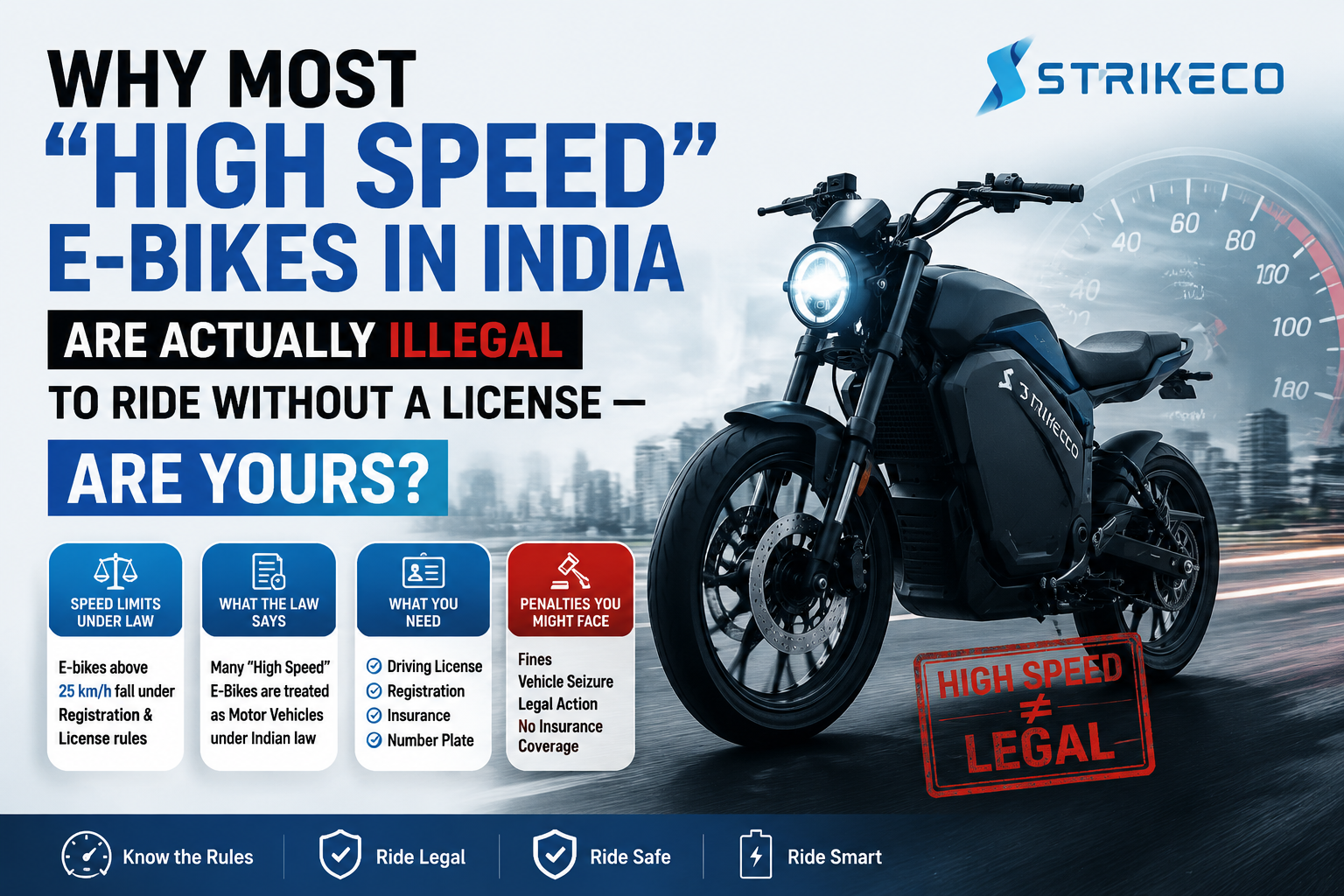
Under the Central Motor Vehicles Rules (CMVR), an electric two-wheeler is legally exempt from registration, driving license, and insurance requirements only if it meets both of the following conditions simultaneously:
Motor power output does not exceed 250W (measured as the 30-minute rated power)
Top speed does not exceed 25 km/h
If a scooter crosses either threshold — more powerful motor, or faster top speed — it is legally classified as a motor vehicle, not a non-motorised vehicle (NMV). Once that happens, the exemption disappears entirely, and it's treated the same as a petrol scooter under the Motor Vehicles Act:
Mandatory RTO registration and a green number plate
A valid driving license (MCWOG category — Motorcycle Without Gear)
Mandatory third-party insurance
Minimum age of 18
Mandatory helmet use (which technically applies to both categories, but is far more commonly ignored on "low-speed" models)
This is the exact classification line that separates a low-speed electric scooter manufacturer's compliance-free product from what most riders actually own: a genuine high speed e-bike.
The Misconception That Gets Buyers Into Trouble
Here's the part most people get wrong, and it's not a small detail — both conditions have to be met, not just one.
A scooter with a powerful motor that's software-limited to 25 km/h is still classified as a high-speed motor vehicle if its actual rated motor power exceeds 250W. Speed-limiting alone doesn't create an exemption. This matters because a growing number of sellers market scooters as "no license needed" simply because the display shows a 25 km/h cap, without disclosing that the underlying motor is rated well above 250W — which means, legally, it still requires registration and a license.
If you've ever seen a scooter advertised with phrases like "ride without RC, no license required" alongside a motor spec of 500W, 750W, or more, that claim doesn't hold up under CMVR rules. It's a marketing shortcut, not a legal fact.
What Happens If You Ride a High-Speed E-Bike Without a License
This isn't just a paperwork technicality. Riding an unregistered, unlicensed high-speed electric vehicle carries the same consequences as riding an unregistered petrol vehicle:
Traffic fines under the Motor Vehicles Act for driving without a valid license and without registration
Vehicle seizure in some states for unregistered motor vehicles
Invalid insurance claims — if your scooter is legally classified as a motor vehicle but isn't registered or insured, any accident claim can be denied outright, leaving you personally liable for damages or injury costs
No legal recourse in an accident — without a valid RC and license, establishing fault or claiming compensation becomes significantly harder
For families and daily commuters, the insurance point is often the one that matters most. A scooter capable of 60-90 km/h that was purchased "informally" without registration isn't just a compliance risk — it removes your financial protection entirely if something goes wrong.
How to Check If Your E-Bike Needs a License
Before assuming your scooter is exempt, verify these directly with the manufacturer or dealer — not the marketing brochure:
Ask for the 30-minute rated motor power (not peak power, which is often quoted separately and can be misleadingly high or low depending on what a seller wants to emphasize)
Confirm the certified top speed, not just a software-limited display reading
Ask whether the model is CMVR-homologated as low-speed or high-speed, and request the certification documentation
Check whether the dealer completes RTO registration as part of the purchase, or leaves it entirely to you
Confirm insurance eligibility — a dealer who can't clearly answer this is a red flag
If a seller can't produce clear motor power and speed certification, or is vague about registration support, that's worth treating as a serious warning sign — not a minor gap.
Where StrikeCo Stands on This
To be transparent: StrikeCo's scooters — including the Cresta, Verv, Electrn, Eco-Sprint, and Eco-Verv — are genuine high-speed electric two-wheelers, built with motors well above the 250W CMVR threshold, because that's what real commuting range, load capacity, and performance require. We don't market any of our two-wheelers as "license-free" or "no RTO needed," because that would be inaccurate and, frankly, sets our customers up for the exact problems described above.
What we do instead, as an electric two-wheeler manufacturer in India:
Every model undergoes proper homologation and certification before it reaches a showroom
Our dealer network is equipped to support customers through the complete RTO registration process, not leave it as an afterthought
We disclose real motor power, battery specifications, and load ratings clearly, rather than hiding behind a speed cap number
We're upfront that riding a StrikeCo two-wheeler requires a valid driving license and registration, exactly as riding any performance petrol scooter would
If you're comparing manufacturers — whether as a retail buyer, a fleet operator, or a prospective dealer evaluating an EV two-wheeler manufacturer in MP — this is a fair question to ask any brand: does your team clearly explain licensing and registration requirements, or does the marketing quietly imply you can skip them?
"High speed" and "license-free" are two claims that, under Indian law, essentially cannot both be true for the same vehicle. If your e-bike is genuinely capable of city and highway speeds — the kind most riders actually want — it almost certainly requires a valid driving license, RTO registration, and insurance. The confusion isn't really about the law; the law is fairly clear. The confusion comes from marketing that blurs the line between a 25 km/h low-speed scooter and a real high-speed electric two-wheeler.
Before you buy, check the two numbers that actually matter — motor wattage and certified top speed — and ask your dealer directly whether registration and license are required. A manufacturer that answers that question clearly, before you've paid, is one worth trusting with the rest of the sale.
Looking for a properly certified, fully road-legal electric scooter with complete registration support? Explore StrikeCo's electric two-wheeler range or find a StrikeCo dealer near you.
Frequently Asked Questions
Q: What's the exact rule for needing a license on an electric scooter in India?
Under CMVR, you're exempt from a license and registration only if the scooter's motor power stays at or below 250W (30-minute rating) and its top speed stays at or below 25 km/h. Exceeding either threshold makes it a motor vehicle requiring a license, RTO registration, and insurance.
Q: My scooter is speed-limited to 25 km/h — does that mean I don't need a license?
Not necessarily. If the motor's rated power exceeds 250W, the scooter is still classified as a high-speed motor vehicle regardless of a software speed cap, and legally requires registration and a license.
Q: What documents should I ask for before buying a "no license needed" e-bike?
Ask for the CMVR homologation certificate confirming motor power and top speed, and get written confirmation from the dealer on whether RTO registration is required for that specific model.
Q: Are StrikeCo scooters license-free?
No. StrikeCo two-wheelers are genuine high-speed electric scooters and legally require a valid driving license and RTO registration, exactly like any performance petrol scooter. We're upfront about this and support customers through the registration process.
Q: What happens if I get caught riding a high-speed e-bike without a license?
You can face traffic fines, potential vehicle seizure in some states, and — critically — your insurance claim can be denied in the event of an accident, leaving you financially exposed.