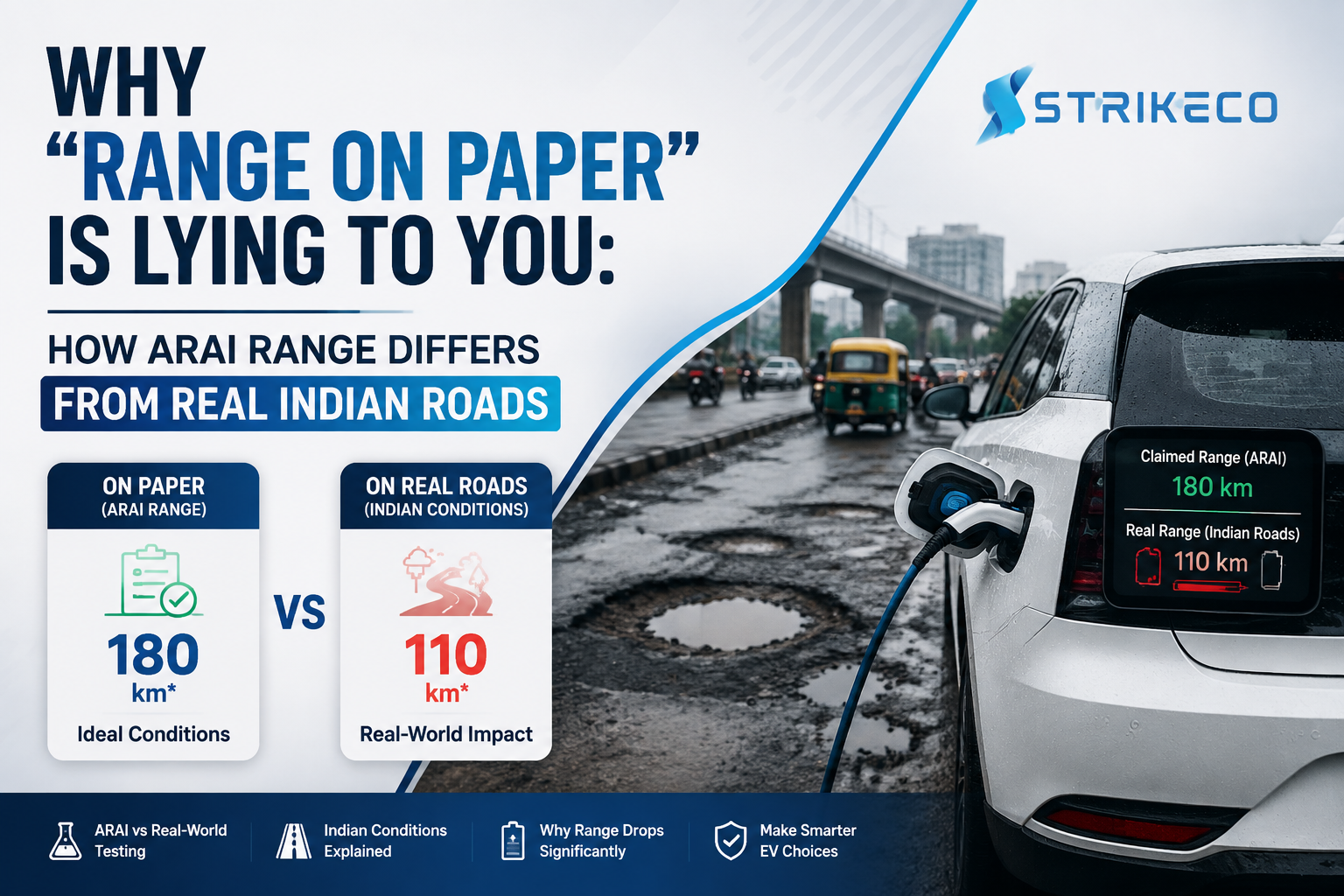
If you've shopped for an electric scooter in India, you've seen the number. It's on the brochure, the showroom banner, the Instagram ad: "100 km range!" It's also, in almost every case, a number you will never see on your actual commute.
This isn't a StrikeCo problem or a competitor problem — it's an industry-wide gap between ARAI-certified range and what riders actually get on Indian roads. As an electric scooter manufacturer in India, we think buyers deserve to understand why that gap exists before they hand over a deposit, not after their first week of riding.
What Is ARAI Range, Actually?
ARAI stands for the Automotive Research Association of India — the government-recognized body that certifies vehicles, including every electric scooter sold by an EV scooter manufacturer in India, before they can legally be sold.
The range figure you see on a spec sheet comes from a standardized lab test, not a road test. The scooter is placed on a machine called a chassis dynamometer (essentially a treadmill for vehicles) and run through a fixed speed-and-stop cycle in a controlled indoor environment — no wind resistance from real air, no incline, no traffic signals, no potholes, and critically, one rider of a fixed standard weight with no luggage.
That test exists so every manufacturer — StrikeCo, Bounce, Okinawa, Zelio, Kinetic Green, all of us — is measured against the same yardstick. It's useful for comparing scooters against each other. It is not designed to predict what happens on Indore's MG Road at 6 PM.
Why Real Indian Roads Never Match the Lab
Here's where the number quietly falls apart, factor by factor.
1. Stop-and-go traffic drains batteries faster than steady speed
ARAI test cycles include braking and acceleration phases, but Indian city traffic — traffic signals every 500 metres, sudden braking for autos, crawling through market areas — is far more aggressive on the battery than any lab cycle. Every acceleration from a dead stop pulls significantly more current than cruising.
2. Rider weight and passenger load
The ARAI test uses a fixed rider weight (typically around 75 kg, single rider, no pillion). In the real world:
A second passenger adds 40-70 kg
A loaded boot space (groceries, delivery boxes, a laptop bag) adds more
Heavier load = higher motor load = faster battery drain
This single factor alone can account for a noticeable chunk of the gap, especially for scooters regularly used with a pillion.
3. Road surface and terrain
Lab dynamometers simulate a flat, smooth surface. Real Madhya Pradesh roads — and Indian roads generally — include:
Potholes and broken tarmac that force constant micro-corrections
Speed breakers every few hundred metres in residential areas
Inclines and flyovers that demand sustained higher motor output
Loose gravel or unpaved stretches on the outskirts of most towns
Motors work harder on uneven or inclined surfaces, and that extra effort comes directly out of your battery's charge.
4. Weather and temperature
Lithium-ion and lead-acid batteries both lose efficiency in temperature extremes. Indore summers regularly cross 40°C, and North Indian winters can dip into single digits — both reduce a battery's effective capacity compared to the controlled lab temperature the ARAI test is conducted in. This is one reason range guides that ignore climate are incomplete; if you're comparing a lithium battery e-bike manufacturer's claimed range, ask what temperature that number assumes.
5. Riding style
Aggressive acceleration, high top-speed cruising, and frequent hard braking all consume more energy than the smooth, moderate-speed profile used in certification testing. Two riders on the identical scooter, riding differently, can see a meaningfully different real-world range.
6. Accessory and auxiliary load
Headlights, indicators, and — on some models — mobile charging ports all draw a small but constant amount of power that adds up over a full day of riding, none of which factors meaningfully into a short lab cycle.
So How Big Is the Gap, Really?
There's no single universal number because it depends on the scooter, rider, and route — but as a rule of thumb that riders, reviewers, and manufacturers across the Indian EV industry broadly acknowledge: expect real-world range to land somewhere between 60-80% of the ARAI-certified figure under typical mixed city riding with a single rider. That gap widens further with a pillion, heavy load, hilly terrain, or extreme weather.
In other words, if a scooter is advertised at 100 km ARAI range, a realistic expectation for daily city use is closer to 65-80 km, and less than that with a passenger and stop-start traffic.
This isn't a flaw unique to one brand. It's physics and lab methodology meeting the reality of Indian streets — and it applies whether you're comparing a StrikeCo scooter, a shared mobility EV, or any other electric two-wheeler in the market.
How StrikeCo Approaches Range Honestly
As an electric two-wheeler manufacturer in India based in Indore, Madhya Pradesh, we test our scooters — including the Cresta, Verv, Electrn, Eco-Sprint, and Eco-Verv — under conditions that reflect how our riders actually use them, not just the certification cycle.
A few things we tell every buyer and dealer upfront:
We publish ARAI figures because we're legally required to and they're useful for comparison — but we explain the realistic range alongside it, not instead of it.
Load capacity matters. Our scooters are rated with clear load limits (for example, the Cresta carries up to 250 kg) specifically because we design for real Indian usage — commuting, family rides, and daily delivery loads — not a single lab-weight rider.
We test across MP's actual road and climate conditions — from Indore's city traffic to highway stretches — so the range guidance our dealers give customers is grounded in reality, not a brochure number.
Our battery and motor specs are disclosed transparently (battery voltage, motor wattage, boot space, load capacity) so buyers and OEM partners can evaluate range expectations themselves rather than relying on a single headline figure.
This is also why range transparency matters if you're evaluating us as a manufacturing or OEM electric scooter manufacturer partner — a dealer who sets accurate rider expectations gets fewer service complaints and higher customer trust than one selling on an inflated number.
What This Means If You're Buying an Electric Scooter
Whether you're comparing StrikeCo to any other electric vehicle manufacturer in MP or nationally, here's a practical checklist:
Ask for real-world range, not just ARAI range — a transparent manufacturer or dealer should be able to give you a realistic city-riding estimate.
Factor in your actual usage — daily distance, whether you regularly carry a pillion, your city's traffic density, and typical load.
Check the battery type and warranty — lithium and lead-acid batteries degrade differently over time, which affects range as the vehicle ages, not just on day one.
Test ride during your actual commute conditions if possible — a showroom test ride on a flat, empty stretch won't tell you much about a 20 km stop-start city commute.
Treat the ARAI number as a ceiling, not a promise.
ARAI range isn't fake or misleading by design — it's a standardized benchmark that exists so scooters can be compared fairly on paper. The problem is when that lab number gets marketed as a real-world promise. As an e-scooter manufacturing company in India, we'd rather set the right expectation upfront than have a customer feel misled three weeks after purchase.
If you're evaluating an electric scooter — for personal use, fleet deployment, or as a dealership opportunity — ask the manufacturer for real-world range data, not just the certificate number. It's a small question that tells you a lot about how transparent that company will be after the sale too.
Looking for a scooter built around real Indian riding conditions, not just lab numbers? Explore StrikeCo's electric scooter range or learn about becoming a StrikeCo dealer in your city.
Frequently Asked Questions
Q: Is ARAI range fake or fraudulent? No. ARAI testing is a mandated, standardized certification process used across the industry. It's accurate for what it measures — a controlled lab cycle — but it isn't designed to replicate real-world riding conditions.
Q: How much less range should I expect in real life?
As a general guideline, expect 60-80% of the ARAI-certified range under typical single-rider city conditions, and less with a pillion, heavy load, hilly terrain, or extreme temperatures.
Q: Do all electric scooter manufacturers in India face this gap?
Yes. This is a universal characteristic of lab-based range certification versus real-world riding, applicable across every EV two-wheeler manufacturer, not specific to any one brand.
Q: Does StrikeCo publish real-world range figures?
StrikeCo discloses full technical specifications — battery, motor, load capacity — for every model, and our dealer network is trained to set realistic range expectations based on actual usage rather than the ARAI figure alone.