The electric vehicle market in India is creating new business opportunities for two-wheeler dealers and automobile distributors. As more customers consider electric scooters for daily commuting, local dealers have an opportunity to expand their businesses by adding EVs to their product portfolio.
However, entering the electric vehicle market is not always straightforward.
Many dealers hesitate to partner with smaller or relatively new EV brands. Their concerns go beyond the vehicle's design or selling price. They want to know whether the brand can support their business, provide consistent product information, help them attract customers and assist when problems arise after a sale.
A dealership is a long-term business relationship. Dealers invest in showroom space, inventory, staff, marketing and customer relationships. Choosing an EV brand without evaluating its business support can create challenges later.
This is where the right brand partnership becomes important.
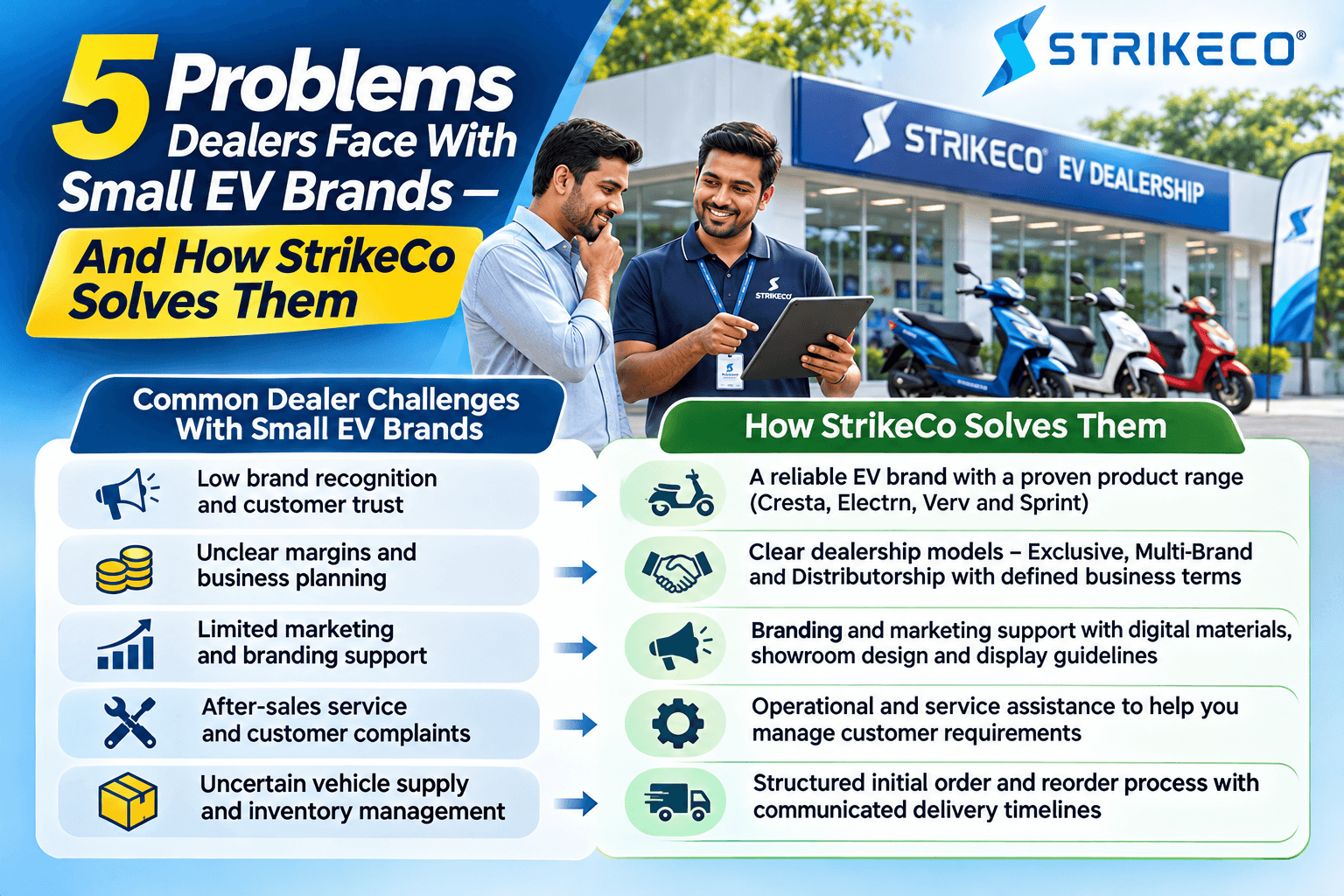
In this article, we explore five common problems dealers face when working with smaller EV brands and how StrikeCo EV approaches these challenges through its dealership models and partner support.
1. Lack of Brand Recognition and Customer Trust
One of the biggest challenges for dealers working with smaller EV brands is building customer confidence.
Customers purchasing an electric scooter often have several questions:
Is the company reliable?
How long has the brand been operating?
What happens if the vehicle develops a problem?
Is technical support available?
Will replacement parts be accessible?
Can the company provide support after the purchase?
When customers are unfamiliar with an EV brand, dealers may need to spend additional time explaining the company, its products and its support arrangements.
This can make the sales process more challenging, particularly when customers are comparing the vehicle with established petrol scooter brands or better-known EV manufacturers.
How StrikeCo Addresses This Challenge
StrikeCo provides dealers with an established product portfolio and different dealership partnership options.
Its electric scooter range includes models such as Cresta, Electrn, Verv and Sprint. Dealers can explore the available models and choose a partnership structure that suits their business.
StrikeCo also offers branding and marketing support through digital marketing materials and design templates. These resources can help dealers present the brand more consistently across their sales and promotional activities.
For dealers, having clear product information and organised branding resources can make customer communication easier.
However, building customer trust also requires transparent product demonstrations, accurate specifications, clear warranty documentation and dependable after-sales support.
2. Unclear Dealership Margins and Business Planning
A second challenge is understanding whether an EV dealership can generate sustainable business returns.
Dealers need clarity about their investment, initial stock requirements, reorder quantities, showroom expenses and expected margins.
Some smaller EV brands may not communicate their dealership structure clearly. This can make it difficult for a potential partner to estimate the resources needed to enter the business.
Before signing an agreement, dealers should understand:
Initial vehicle order requirements.
Reorder quantities.
Showroom or warehouse requirements.
Territory arrangements.
Marketing responsibilities.
Payment and dispatch conditions.
Applicable dealer margins and incentives.
Without this information, planning inventory and managing cash flow can become difficult.
How StrikeCo Addresses This Challenge
StrikeCo offers three dealership formats designed for different business requirements.
Exclusive Dealership: A dedicated StrikeCo EV showroom for partners who want to focus on the brand.
Multi-Brand Dealership: An option for existing automobile dealers who want to add StrikeCo electric scooters to their current showroom.
Distributorship: A model for businesses interested in supplying vehicles across a wider regional market.
The company also publishes model-specific initial order and reorder requirements, along with space and branding guidelines.
This gives potential partners a clearer starting point for evaluating which dealership model suits their business.
StrikeCo also highlights scalable profit margins as part of its dealership opportunity. Dealers should request the current written commercial terms, including applicable margins, incentives and other conditions, before making an investment decision.
3. Limited Marketing and Branding Support
Opening an EV dealership is only the first step. Attracting customers and generating regular enquiries require consistent marketing.
Many local dealers have strong sales experience but may not have dedicated marketing teams.
They may struggle with:
Creating professional advertisements.
Promoting vehicles on social media.
Designing showroom branding.
Explaining EV benefits to potential customers.
Generating local enquiries.
Running promotional campaigns.
Maintaining a consistent brand identity.
When a manufacturer provides little marketing assistance, the dealer may need to manage these activities independently.
This adds work and can increase the cost of promoting a new EV brand.
How StrikeCo Addresses This Challenge
StrikeCo's dealership programme includes digital marketing support and design templates.
These resources can help dealers maintain consistent brand communication when promoting vehicles through online channels.
The company also provides branding and display guidelines for its dealership formats. Exclusive dealership partners receive full showroom design support, while multi-brand dealers receive branding and display guidelines.
This gives dealers a foundation for presenting StrikeCo products professionally.
Local marketing execution remains an important part of the dealer's responsibility. Dealers should combine the available brand resources with local promotions, customer demonstrations, social media campaigns and community-level marketing.
For example, an existing automobile showroom can introduce StrikeCo electric scooters through:
Local social media promotions.
Test-ride campaigns.
EV awareness activities.
Customer referral programmes.
Local business partnerships.
Product demonstration events.
The combination of brand-level resources and local dealer marketing can help improve product visibility in the target market.
4. Difficulty Managing After-Sales Service and Customer Complaints
After-sales service is one of the most important factors in the electric vehicle business.
A customer may be satisfied with a scooter at the time of purchase, but their long-term experience depends on how the brand and dealer respond when problems arise.
Common customer concerns include:
Battery performance.
Charging-related problems.
Motor or controller issues.
Electrical faults.
Replacement part availability.
Regular servicing requirements.
Warranty-related questions.
These problems can become difficult for dealers when the manufacturer does not provide clear technical guidance or an organised support process.
The dealer often becomes the first point of contact for customer complaints, even when the problem requires manufacturer-level assistance.
This can affect customer satisfaction and the dealer's reputation.
How StrikeCo Addresses This Challenge
StrikeCo lists operational and service assistance as part of its dealership offering.
This is important because dealers need more than a vehicle supply arrangement. They also need access to operational guidance and assistance when handling customer requirements.
Before joining, dealers should understand the exact scope of this support, including:
How technical issues are reported.
Who handles warranty-related cases.
How replacement parts are requested.
What training is available for service staff.
How customer complaints are escalated.
What service responsibilities remain with the dealer.
A clear understanding of these processes helps dealers prepare their teams and set realistic expectations with customers.
StrikeCo's operational and service assistance offering provides a starting point for this partnership discussion. Dealers should obtain the detailed service and warranty procedures in writing before finalising their agreement.
5. Uncertainty Around Vehicle Supply and Inventory Management
Inventory management is another major concern for EV dealers.
Maintaining too much stock can block working capital, while insufficient stock can result in missed sales opportunities.
Dealers need to understand the manufacturer's order process, dispatch timelines and reorder requirements.
This becomes particularly important when demand changes due to local market conditions, seasonal requirements or promotional campaigns.
Without clear communication, dealers may find it difficult to plan vehicle availability and manage customer expectations.
How StrikeCo Addresses This Challenge
StrikeCo publishes initial order and reorder structures for its different dealership formats.
Its dealership programme distinguishes the requirements for exclusive dealers, multi-brand dealers and distributors.
This allows potential partners to understand the inventory commitment associated with each model before applying.
The company also states that delivery timelines are shared after order quantity confirmation and receipt of full payment, subject to its published dealership terms.
For dealers, this makes it important to discuss stock planning and expected dispatch schedules before placing orders.
A practical inventory plan should consider:
Local customer demand.
Popular vehicle models.
Expected sales activity.
Available showroom space.
Reorder lead times.
Working capital availability.
Seasonal demand variations.
Dealers should confirm stock availability and dispatch expectations directly with StrikeCo before making commitments to customers.
Why Dealers Should Evaluate More Than Just the EV Product
A good electric scooter is important, but the quality of the dealership partnership also influences the business experience.
Before choosing an EV brand, dealers should evaluate the complete business arrangement.
Some important factors include:
Product portfolio: Does the brand offer models that suit different customer requirements?
Dealership structure: Can the partnership model accommodate the dealer's existing business?
Initial investment: Are the financial requirements clear?
Dealer margins: Are commercial terms transparent?
Marketing assistance: Does the brand provide resources to support customer acquisition?
Service assistance: Is there a clear process for handling customer concerns?
Spare-parts availability: Can the dealer understand how replacement parts are sourced?
Warranty process: Are warranty responsibilities and procedures clearly explained?
Supply and reorder process: Can the dealer plan inventory effectively?
Territory arrangements: Is the sales area and its associated arrangement clearly defined?
The most suitable EV brand is not necessarily the one offering the lowest initial investment. Dealers should consider the complete partnership, including product quality, commercial terms, service support and long-term business requirements.
Which StrikeCo Dealership Model Is Right for Your Business?
StrikeCo offers different partnership formats to accommodate businesses with different operational capabilities.
Exclusive Dealership
This model is suitable for entrepreneurs or automobile businesses interested in operating a dedicated StrikeCo EV showroom.
It provides a brand-focused showroom format with showroom design support and defined order requirements.
Multi-Brand Dealership
This model is suitable for existing two-wheeler and automobile dealers who want to expand their product portfolio without creating a completely separate showroom.
It allows dealers to introduce StrikeCo electric scooters alongside their existing vehicle brands.
Distributorship
This model is intended for businesses interested in regional distribution and supplying vehicles across a wider market.
It is more suitable for partners with the infrastructure and operational capability to manage distribution activities.
The right model depends on the dealer's existing business, available space, working capital, local market potential and distribution experience.
Frequently Asked Questions
1. Why do dealers hesitate to partner with small EV brands?
Dealers may be concerned about brand recognition, product reliability, spare-parts availability, after-sales service, warranty handling, marketing support and long-term business viability.
2. Does StrikeCo offer different dealership models?
Yes. StrikeCo offers exclusive dealership, multi-brand dealership and distributorship options. Each model has different operational and inventory requirements.
3. Does StrikeCo provide marketing support to dealers?
StrikeCo lists digital marketing support and design templates as part of its dealership offering. It also provides branding and display guidelines, with full showroom design support for exclusive dealership partners.
4. Can an existing automobile dealer become a StrikeCo partner?
Yes. The multi-brand dealership format is designed for existing businesses that want to add StrikeCo electric scooters to their current showroom.
5. Does StrikeCo provide after-sales assistance?
StrikeCo lists operational and service assistance as part of its dealer support offering. Prospective partners should confirm the specific technical support, warranty procedures, training and spare-parts arrangements before signing an agreement.
6. How can someone apply for a StrikeCo dealership?
Interested businesses can visit the official StrikeCo dealership page, review the available partnership models and contact the company to discuss their requirements.
Conclusion
The electric vehicle market offers promising opportunities for automobile dealers, but selecting the right EV brand is essential for building a sustainable business.
Dealers need more than an attractive product. They need a clear dealership structure, practical marketing resources, operational assistance, transparent commercial terms and a defined approach to customer support.
StrikeCo aims to address these business requirements through its exclusive dealership, multi-brand dealership and distributorship models. Its published programme includes branding and marketing resources, operational and service assistance, and different partnership structures for businesses with different needs.
If you are an automobile dealer, distributor or entrepreneur planning to enter the electric vehicle market, evaluating the right partnership is an important first step.
Explore the StrikeCo EV dealership opportunities and find a partnership model that aligns with your business goals.