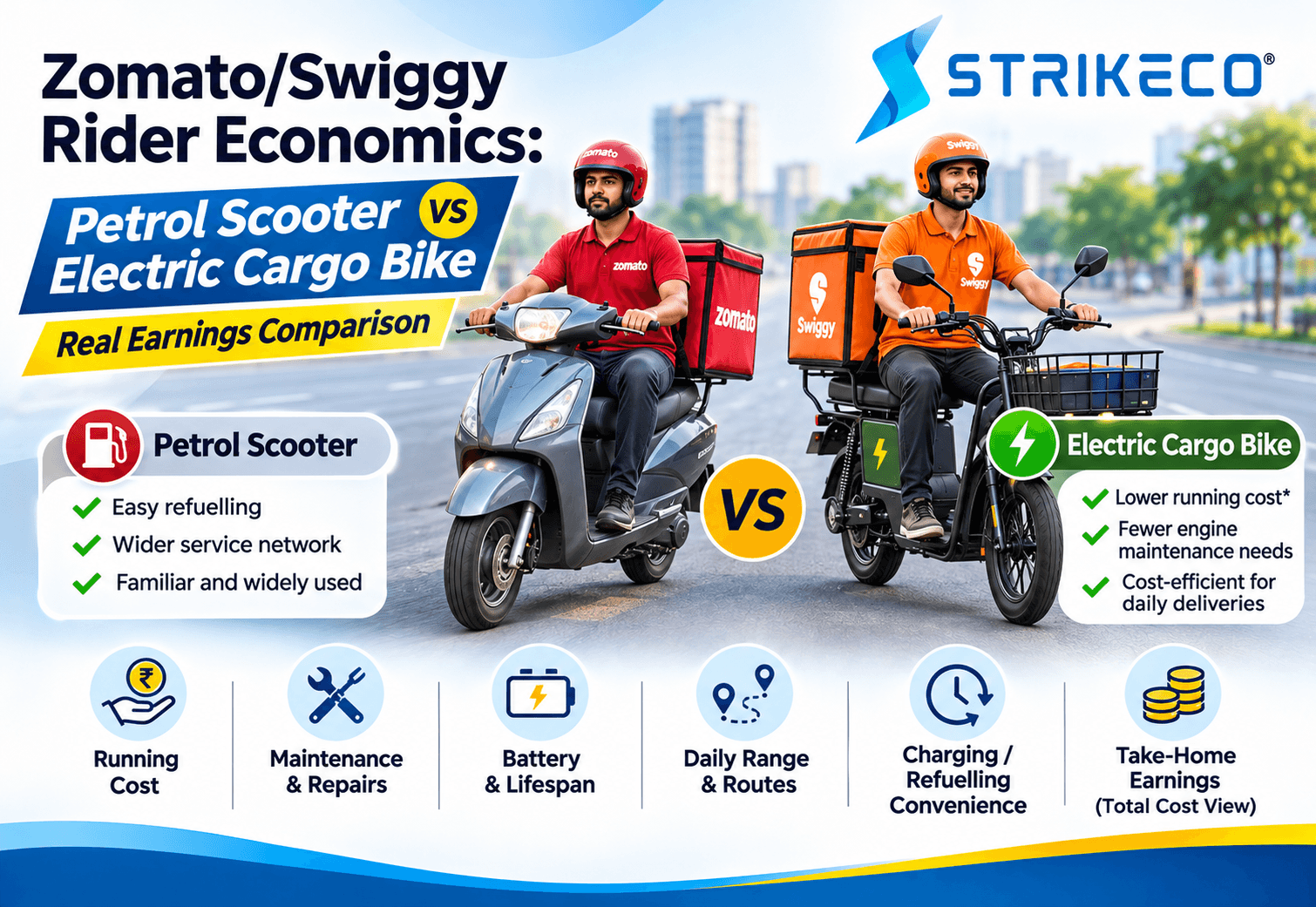
Food delivery platforms such as Zomato and Swiggy have created earning opportunities for thousands of delivery partners across India. Whether someone works full-time or uses delivery as a part-time income source, choosing the right vehicle can make a significant difference to their daily expenses and overall earnings.
For many delivery partners, a petrol scooter is the traditional choice. It offers flexibility, easy refuelling and access to a familiar service network. However, rising fuel expenses can reduce the money riders take home, particularly when they travel long distances every day.
Electric cargo bikes are becoming another option for delivery professionals. With lower energy costs per kilometre in many operating conditions and fewer routine mechanical requirements, they may help riders manage their daily operating expenses.
But which option is actually better for a Zomato or Swiggy delivery partner?
The answer depends on more than just petrol and electricity costs. Riders need to consider vehicle purchase or rental expenses, battery performance, charging access, maintenance, delivery distance, working hours and the number of orders they complete.
This guide compares petrol scooters and electric cargo bikes from a practical earning perspective.
1. Understanding the Economics of Food Delivery Work
Before comparing vehicles, it is important to understand how delivery partners earn money.
A delivery partner's income generally depends on several factors:
Number of orders completed.
Distance travelled for each delivery.
Delivery incentives and bonuses.
Peak-hour demand.
Availability of orders in the assigned area.
Customer tips, where applicable.
Working hours and days.
Platform-specific payment structures.
However, the money received from delivery work is not the same as actual take-home earnings.
Riders must also pay for the expenses involved in operating their vehicles. These may include fuel or electricity, maintenance, tyres, insurance, servicing, vehicle rentals or loan payments, and battery-related expenses.
For this reason, comparing petrol and electric vehicles based only on their purchase price or energy cost can be misleading.
The more useful question is:
How much money does a rider retain after covering all vehicle-related operating expenses?
2. Petrol Scooter vs Electric Cargo Bike: Understanding the Difference
Both vehicles can support delivery work, but their operating characteristics are different.
Petrol Scooter
Petrol scooters are widely used by food delivery partners because they are easy to refuel and have an established service network.
Their main advantages include:
Convenient refuelling at petrol stations.
Familiar operation for most riders.
No need to plan charging stops.
Availability of repair shops and replacement parts.
Flexibility for longer journeys where charging access may be limited.
However, petrol scooters have recurring fuel expenses. Riders who travel extensively throughout the day may spend a significant portion of their delivery income on petrol.
They also require regular maintenance involving engine oil, air filters, spark plugs and other engine-related components.
Electric Cargo Bike
An electric cargo bike is designed to support electrically assisted transportation and carrying requirements. Depending on its design, it may offer a useful alternative for delivery operations.
Potential advantages include:
Lower energy costs per kilometre in many operating conditions.
No petrol or engine oil expenses.
Fewer engine-related maintenance requirements.
Quiet operation.
Potentially lower operating costs for frequent short-distance deliveries.
However, riders must consider battery range, charging availability, charging time, battery replacement costs and the vehicle's load capacity.
Not every electric cargo bike is suitable for every delivery platform or operating area. Riders should also verify vehicle registration, insurance, licensing and applicable local transport requirements before choosing one.
3. Petrol Scooter vs Electric Cargo Bike: Operating Cost Comparison
The biggest difference between these two options is often the way their running expenses are structured.
No conventional petrol engine servicing
Battery maintenance
Starter battery, where fitted
Main traction battery and electrical system
Electric vehicles can have lower routine maintenance requirements because they do not use conventional petrol engines. However, they are not maintenance-free.
Tyres, brakes, suspension, electrical connections and other components still require regular inspection.
The battery is also an important long-term expense. Its condition, usable capacity, charging performance and eventual replacement cost should be included when calculating the total cost of ownership.
4. How Petrol Expenses Affect a Delivery Rider's Earnings
For petrol scooter users, fuel is one of the recurring expenses that directly affects take-home income.
Consider a rider who spends a large part of the day travelling between restaurants, customer locations and delivery zones.
Fuel consumption depends on:
Total distance travelled.
Traffic congestion.
Riding speed.
Frequent acceleration and braking.
Vehicle condition.
Passenger or cargo load.
Road conditions.
In congested urban areas, frequent stops and slow-moving traffic can affect fuel efficiency.
This creates a challenge for riders who depend on delivery work as their primary source of income. Even when order volumes are good, increasing fuel expenses can reduce the amount they retain.
Petrol scooters may still be a practical choice for riders who work across wider delivery areas, have irregular schedules or cannot access convenient charging facilities.
5. How Electric Cargo Bikes Can Improve Delivery Economics
Electric cargo bikes offer a different approach to managing daily transportation expenses.
Instead of purchasing petrol, riders use electricity to charge the vehicle's battery. Depending on electricity tariffs, vehicle efficiency, battery condition and riding conditions, the cost of travelling a kilometre may be lower than with a petrol scooter.
This can be particularly useful for riders who complete frequent deliveries within a defined urban area.
Lower Energy Expenses
Electricity can cost less per kilometre than petrol under suitable operating conditions.
For a rider who travels regularly, the difference in energy expenses can contribute to better operating margins.
However, actual savings depend on the vehicle's energy consumption, battery capacity, electricity tariff and charging arrangement.
Reduced Engine Maintenance
An electric motor does not require conventional engine oil changes, spark plug replacements or air filter servicing.
This can reduce certain routine maintenance expenses.
Nevertheless, riders should budget for tyre wear, brake servicing, suspension maintenance, electrical inspections and battery-related expenses.
Better Suitability for Certain Delivery Routes
Electric cargo bikes may be useful for delivery operations involving shorter and more predictable routes.
For example, riders working within a limited neighbourhood or a compact restaurant delivery zone may find it easier to plan charging around their daily schedules.
The suitability of the vehicle depends on its real-world range, payload capacity, speed and the rider's delivery requirements.
6. Battery Range and Charging: The Biggest Considerations for EV Delivery Partners
For electric delivery vehicles, battery performance plays an important role in daily productivity.
A rider cannot evaluate an electric cargo bike only by looking at its advertised range. The actual distance available during delivery work may change depending on several factors.
These include:
Total vehicle and cargo weight.
Rider weight.
Road conditions.
Traffic and stop-start riding.
Riding speed.
Weather and temperature.
Battery age and condition.
Tyre pressure.
Motor efficiency.
A vehicle that provides sufficient range during light personal use may deliver a different result when carrying delivery loads throughout the working day.
Why Battery Quality Matters
A battery is one of the most important components of an electric cargo bike.
Its quality and performance influence how reliably the vehicle can complete daily delivery routes.
When evaluating an electric cargo bike, riders and fleet operators should consider:
Battery chemistry and specifications.
Usable battery capacity.
Real-world range under load.
Charging time.
Battery management system protection.
Warranty and after-sales support.
Availability and cost of replacement batteries.
Choosing a suitable battery system can help reduce operational interruptions and support more consistent delivery work.
7. Daily Earnings vs Actual Take-Home Income
A rider may receive good delivery payments but still retain less money than expected because of vehicle expenses.
To understand the difference, riders should separate gross delivery income from net operating income.
A simple way to evaluate earnings is:
Net operating income = Gross delivery income – Vehicle operating expenses
Vehicle operating expenses may include:
Petrol or electricity.
Vehicle servicing and repairs.
Tyres and brake replacements.
Insurance and applicable vehicle expenses.
Rental or financing payments.
Battery depreciation or replacement provision.
For a fair comparison, riders should calculate these expenses over the same working period and similar delivery distances.
For example, a petrol scooter rider and an electric cargo bike rider may complete similar delivery work. The petrol rider needs to account for fuel consumption and engine maintenance, while the electric rider needs to account for electricity, battery depreciation and charging arrangements.
The vehicle with the lower purchase price is not necessarily the vehicle with the better long-term economics.
8. Example: How to Compare Both Vehicles Without Assuming Fixed Earnings
Instead of relying on generic online earning claims, delivery partners can use their own work data to compare the two options.
Consider these two hypothetical riders:
Rider A – Petrol Scooter
Works regularly on food delivery platforms.
Travels across multiple delivery locations.
Pays for petrol throughout the working period.
Has recurring engine servicing expenses.
Can refuel quickly whenever required.
Rider B – Electric Cargo Bike
Works within a more predictable delivery area.
Uses an electric vehicle for daily deliveries.
Pays for charging electricity.
Plans charging around working hours.
Needs to account for battery ageing and replacement.
Both riders may receive similar delivery payments if their completed orders and incentives are comparable.
However, their take-home income may differ because of their operating expenses.
The electric rider may retain more money when electricity and maintenance expenses are lower than the corresponding petrol scooter expenses. But this advantage can reduce if the rider faces expensive charging arrangements, frequent battery replacement, insufficient range or long charging interruptions.
This is why actual rider data is more useful than general claims about how much someone can earn using an electric vehicle.
9. Which Vehicle Is Better for Different Types of Delivery Partners?
There is no single vehicle that is best for every delivery partner.
The right choice depends on the rider's work pattern.
Full-Time Delivery Partners
Riders who work for extended periods and travel regularly may benefit from evaluating an electric vehicle because recurring energy expenses can have a greater impact on their operating costs over time.
However, they should ensure that the battery range and charging arrangements support their working schedule.
Part-Time Delivery Partners
Part-time riders may prefer petrol scooters if they already own one and do not travel enough to justify purchasing another vehicle.
An electric cargo bike may still be attractive if it can be used for other daily transportation needs.
Riders Working in Dense Urban Areas
Electric cargo bikes may be suitable for riders operating within compact delivery zones where distances are relatively predictable and charging is convenient.
Riders Covering Long or Unpredictable Routes
Petrol scooters may offer greater convenience where charging access is limited or delivery routes frequently extend beyond the practical range of an electric vehicle.
The decision should be based on the rider's actual delivery pattern rather than assumptions about either technology.
10. Important Factors to Check Before Buying an Electric Cargo Bike
Before switching from a petrol scooter, delivery partners should evaluate more than the advertised range or vehicle price.
Here are some important considerations:
1. Real-world battery range
Ask for performance information under realistic riding conditions, including rider and cargo load.
2. Battery quality
Understand the battery chemistry, capacity, warranty and expected performance over time.
3. Charging convenience
Check whether you can charge the vehicle at home or at a suitable workplace location.
4. Payload capacity
Ensure the vehicle can safely carry the rider and permitted delivery load.
5. Service support
Check the availability of service centres, spare parts and qualified technicians.
6. Battery replacement
Understand the replacement process, warranty coverage and long-term battery costs.
7. Legal and platform requirements
Verify applicable vehicle classification, registration, insurance, licence requirements and whether the platform permits the specific vehicle for delivery work.
A low-cost vehicle that cannot reliably complete daily deliveries may eventually become more expensive because of lost working time.
11. A Simple Method to Calculate Your Own Delivery Vehicle Savings
Before changing vehicles, collect your existing petrol scooter expenses and compare them with the estimated operating expenses of an electric cargo bike.
Use the following calculation:
Current petrol scooter operating cost
Petrol expense + servicing + repairs + tyres + other vehicle expenses.
Estimated electric cargo bike operating cost
Electricity expense + servicing + repairs + tyres + battery depreciation or replacement provision + other vehicle expenses.
Then compare both totals over the same period.
Also include the difference in purchase price, rental charges or financing payments.
A useful comparison should account for:
How many days you work.
How far you travel.
How many deliveries you complete.
How much time charging takes.
How often the vehicle needs servicing.
Whether the vehicle can complete your daily route without interruption.
This approach helps delivery partners make a decision based on their own earnings and operating conditions instead of relying on fixed savings claims.
Frequently Asked Questions
1. Is an electric cargo bike better than a petrol scooter for Zomato and Swiggy delivery?
It depends on delivery distance, daily working hours, charging availability, vehicle range and operating expenses. Electric cargo bikes may offer lower energy costs, while petrol scooters can be more convenient for unpredictable routes and areas with limited charging access.
2. Can I use an electric cargo bike for food delivery?
That depends on the vehicle's design, applicable legal requirements and the delivery platform's vehicle eligibility rules. Check the relevant platform requirements before purchasing one.
3. Do electric cargo bikes reduce delivery expenses?
They may reduce energy and certain routine maintenance expenses compared with petrol scooters. However, electricity costs, battery depreciation, charging arrangements and vehicle purchase or rental costs must also be considered.
4. How important is battery quality for delivery vehicles?
Battery quality is extremely important because delivery work involves regular usage and repeated charging. Battery capacity, durability, thermal protection, charging performance and after-sales support all influence vehicle reliability.
5. Is an electric cargo bike suitable for full-time delivery work?
It can be suitable if its real-world range, payload capacity, charging time and service support match the rider's daily requirements.
6. How can delivery partners calculate their actual earnings?
Subtract fuel or electricity, maintenance, repairs, insurance, rental or financing payments and battery-related expenses from gross delivery income. Comparing these costs over the same working period gives a more realistic picture of take-home earnings.
Conclusion
For Zomato and Swiggy delivery partners, choosing between a petrol scooter and an electric cargo bike is ultimately a financial decision as much as a transportation decision.
Petrol scooters offer convenient refuelling and established service support. However, recurring petrol and engine maintenance expenses can reduce the income retained by riders who travel frequently.
Electric cargo bikes offer the potential for lower energy expenses and fewer engine-related maintenance requirements. Their financial advantage depends on battery quality, real-world range, charging access, vehicle reliability and the rider's delivery pattern.
Rather than choosing a vehicle based only on its initial price or advertised range, delivery partners should compare the total cost of ownership and estimate their actual net earnings.
For riders and fleet operators considering the transition to electric delivery vehicles, investing in a reliable EV battery system is an important part of building a practical and sustainable delivery operation.