Electric scooters are becoming an increasingly popular choice for daily transportation across India. With growing interest in electric mobility, buyers are paying more attention to battery technology, driving range, charging time and long-term maintenance before choosing a scooter.
If you are researching the best electric scooters in Madhya Pradesh, one important factor to consider is the type of battery used in the vehicle.
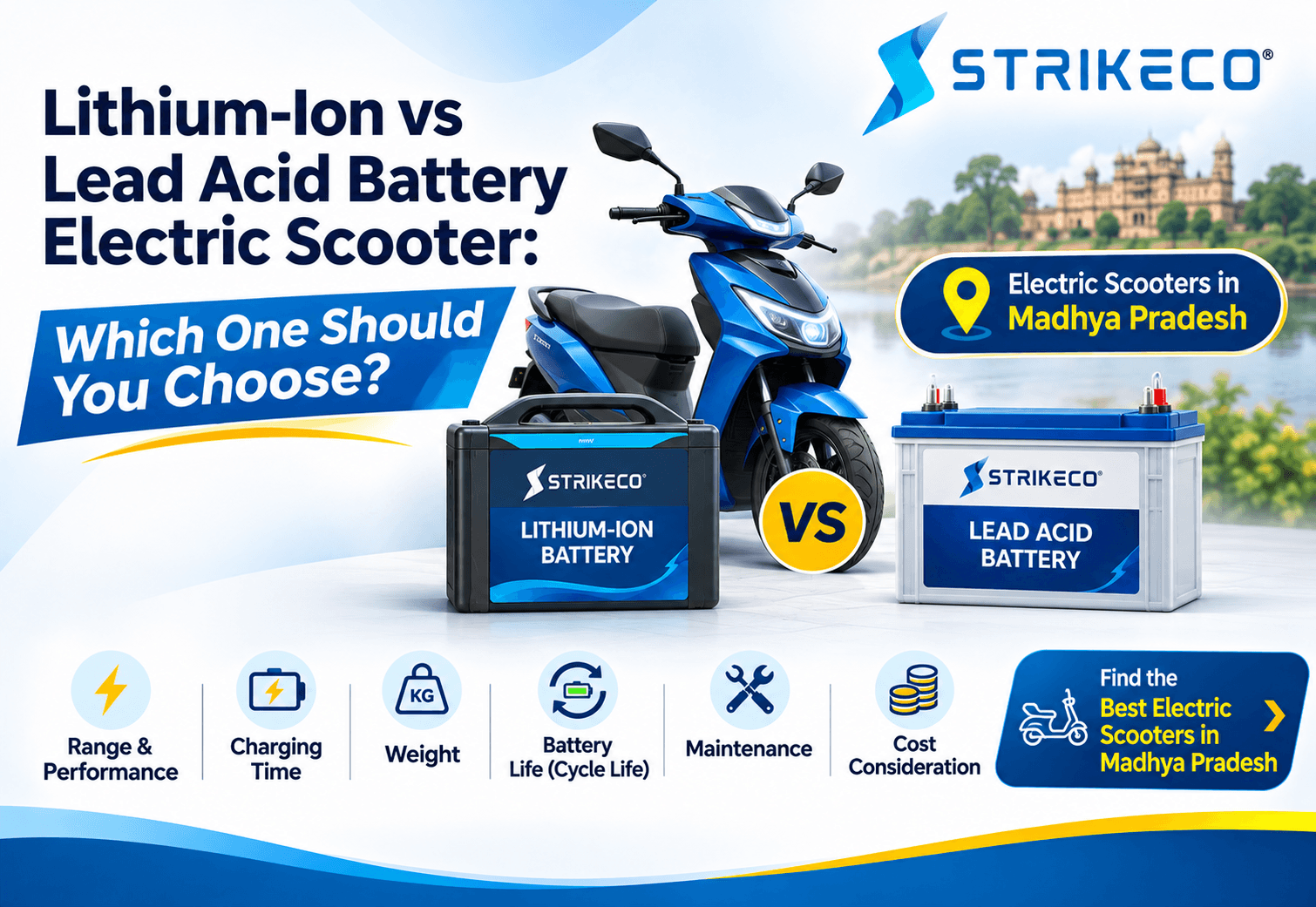
Most electric scooters using these technologies rely on either lithium-ion or lead-acid batteries. Both can power electric vehicles, but they differ significantly in weight, energy storage, charging requirements, lifespan and overall performance.
So, which battery is better for an electric scooter? Is lithium-ion worth considering over lead-acid, or can a lead-acid battery still be a practical option?
Let's compare both technologies and understand what buyers should consider before choosing an electric scooter.
1. Understanding Lithium-Ion Batteries in Electric Scooters
Lithium-ion batteries are widely used in modern electric scooters because of their high energy density, relatively low weight and ability to support repeated charging and discharging.
They store electrical energy through electrochemical reactions involving lithium ions moving between the battery's electrodes.
One important advantage is that lithium-ion batteries can store more energy relative to their weight compared with conventional lead-acid batteries.
This makes them suitable for electric vehicles where weight, range and performance are important considerations.
Key Features of Lithium-Ion Batteries
Higher energy density.
Lower weight compared with similar-capacity lead-acid batteries.
Generally longer cycle life.
Better usable capacity in many EV applications.
Relatively faster charging, depending on the battery and charger.
Low routine maintenance requirements.
Battery Management System (BMS) for monitoring and protection.
Lithium-ion batteries are available in different chemistries, including Lithium Nickel Manganese Cobalt Oxide (NMC) and Lithium Iron Phosphate (LFP). Their performance, energy density, cycle life and thermal characteristics differ.
2. Understanding Lead-Acid Batteries in Electric Scooters
Lead-acid batteries are an established rechargeable battery technology used in vehicles, backup systems and various electrical applications.
They use lead-based electrodes and a sulphuric acid electrolyte to store and release electrical energy.
Lead-acid batteries have been used in electric two-wheelers, particularly in older and budget-oriented scooter designs.
Their relatively simple construction and established manufacturing processes make them a familiar battery technology.
Key Features of Lead-Acid Batteries
Established battery technology.
Generally lower initial cost.
Widely understood maintenance requirements.
Relatively heavy construction.
Lower energy density than lithium-ion batteries.
Generally shorter cycle life in comparable EV applications.
More sensitive to repeated deep discharge.
Lead-acid batteries can still serve certain applications, but their weight and lower energy density make them less suitable for many modern electric scooter designs.
3. Lithium-Ion vs Lead-Acid Battery: Key Differences
Understanding the differences between these battery technologies can help you make a better purchasing decision.
Comparison factor
Lithium-ion battery
Lead-acid battery
Energy density
Higher
Lower
Weight
Lighter
Heavier
Charging time
Generally faster
Generally slower
Cycle life
Generally longer
Generally shorter
Usable capacity
Generally higher
More limited, especially for longer service life
Maintenance
Usually low routine maintenance
May require periodic maintenance depending on type
Initial cost
Generally higher
Generally lower
Deep discharge performance
Generally better, depending on chemistry
Repeated deep discharge can reduce lifespan
Battery monitoring
Typically uses a BMS
Depends on battery and vehicle design
EV suitability
Widely used in modern electric scooters
Found in some older and budget-oriented models
Actual performance depends on battery chemistry, manufacturer, capacity, charging conditions, temperature and vehicle design.
4. Which Battery Offers Better Driving Range?
Driving range is one of the most important considerations when purchasing an electric scooter.
Lithium-ion batteries generally offer better energy storage relative to their weight. This allows manufacturers to design lighter battery packs that can provide useful driving range without adding excessive weight to the scooter.
Lead-acid batteries require more weight and volume to store a comparable amount of energy.
This can affect the overall weight of the vehicle and its energy efficiency.
However, the actual range of an electric scooter depends on several factors:
Battery capacity in kWh.
Motor efficiency.
Vehicle weight.
Rider weight and load.
Riding speed.
Road conditions.
Tyre pressure.
Weather and temperature.
Acceleration and braking patterns.
When comparing electric scooters, look beyond the advertised range. Check the battery capacity and consider the expected real-world riding conditions.
5. Which Battery Charges Faster?
Charging time is another important difference between lithium-ion and lead-acid batteries.
Lithium-ion batteries generally support higher charging rates than conventional lead-acid batteries, provided the cells, BMS and charger are designed for them.
Lead-acid batteries typically require longer charging periods, particularly after significant discharge.
The actual charging time depends on:
Battery capacity.
Charger output.
Battery chemistry.
Current state of charge.
Charging temperature.
Battery Management System limitations.
For people who use their electric scooters every day, shorter charging times can make lithium-ion technology more convenient.
However, always use a charger compatible with the battery pack. A charger with a higher output rating does not mean every battery can safely accept that charging current.
6. Which Battery Lasts Longer?
Battery lifespan is an important factor when comparing long-term ownership.
Lithium-ion batteries generally offer more charge-discharge cycles than conventional lead-acid batteries under comparable operating conditions.
A charge cycle refers to the equivalent use of 100% of the battery's capacity. It does not necessarily mean that the battery must be discharged completely in one session.
Lead-acid batteries can experience faster degradation when regularly subjected to deep discharge or prolonged undercharging.
Lithium-ion batteries also gradually lose capacity, but their cycle life can be considerably higher depending on the chemistry and operating conditions.
Battery lifespan is influenced by:
Charging habits.
Depth of discharge.
Operating temperature.
Charging current.
Battery quality.
Maintenance and storage.
Battery Management System performance.
A research study published in Clean Energy by Oxford University Press compared battery technologies used in Indian electric two-wheelers and discussed the technical and economic advantages of lithium-ion batteries over lead-acid alternatives.
7. How Does Battery Weight Affect Electric Scooter Performance?
Battery weight directly contributes to the overall weight of an electric scooter.
This can influence vehicle handling, acceleration and energy consumption.
Lithium-Ion Batteries
Lithium-ion batteries have higher energy density, allowing them to store more energy for a given weight.
This makes it possible to design lighter electric scooters with more efficient battery packaging.
Potential advantages include:
Lower overall vehicle weight.
More efficient energy use.
Better handling characteristics.
More flexibility in battery placement.
Lead-Acid Batteries
Lead-acid batteries are considerably heavier for comparable energy storage.
The additional weight can affect vehicle efficiency and handling, particularly in smaller electric scooters.
For people who frequently ride through traffic or need to move their scooter manually, battery weight can be an important consideration.
8. Which Battery Is Better for Madhya Pradesh's Riding Conditions?
When exploring electric scooters in Madhya Pradesh, buyers should consider their daily travel requirements and the conditions in which they will use the vehicle.
Different cities and towns have different road conditions, commuting distances and charging facilities.
For example, a person commuting within Indore or Bhopal may have different requirements from someone using an electric scooter for longer daily journeys in a smaller town.
Here are a few factors worth considering.
Daily Commuting Distance
If you travel longer distances every day, battery capacity, usable energy and cycle life become important.
Lithium-ion batteries are generally better suited to regular and demanding EV usage.
Temperature Conditions
Some parts of Madhya Pradesh experience high summer temperatures.
Battery performance and lifespan can be affected by excessive heat. Choose a battery pack with suitable operating temperature limits and an appropriate thermal protection system.
Avoid leaving an electric scooter exposed to direct sunlight for extended periods.
Charging Convenience
Consider where and how you will charge your scooter.
If you depend on daily charging, charging time and charger compatibility can influence convenience.
Maintenance Requirements
Consider how frequently the battery requires maintenance and whether authorised service support is available.
Lithium-ion battery packs generally require less routine maintenance than conventional flooded lead-acid batteries, although their electrical systems still need appropriate inspection and servicing.
9. What Should You Check Before Buying an Electric Scooter?
If you are comparing the best electric scooters in Madhya Pradesh, do not make your decision based only on appearance, advertised speed or initial purchase cost.
Review the following specifications before choosing a model.
1. Battery Chemistry
Check whether the scooter uses lithium-ion, LFP, NMC or lead-acid technology.
2. Battery Capacity
Battery capacity, usually expressed in kWh or Ah alongside voltage, helps you understand how much energy the battery can store.
3. Certified or Tested Range
Compare the advertised range with independent test information and realistic riding expectations.
4. Charging Time
Check the recommended charging duration and whether a compatible charger is included.
5. Battery Warranty
Review the warranty duration, coverage conditions and exclusions.
6. BMS Protection
For lithium-ion scooters, check the battery management and protection features.
7. Service Availability
Consider the availability of authorised service centres and battery replacement support in your area.
8. Battery Replacement and Support
Understand the replacement process, warranty support and availability of compatible battery packs.
10. Lithium-Ion or Lead-Acid: Which One Should You Choose?
Both battery technologies have specific advantages, but lithium-ion is generally the preferred choice for modern electric scooters.
Choose lithium-ion if:
You travel regularly or cover longer distances.
You prefer a lighter electric scooter.
Faster charging is important.
You want a longer cycle life.
You prefer lower routine battery maintenance.
Lead-acid may be considered if:
Your budget is limited.
Your daily travel requirements are modest.
The scooter is specifically designed for that battery type.
You are comfortable with its weight and maintenance requirements.
For most modern electric scooter buyers, lithium-ion offers a stronger combination of energy density, weight, cycle life and charging convenience.
However, the final decision should depend on the complete vehicle specifications, battery quality, warranty and availability of service support.
Lithium-ion and lead-acid batteries are two different technologies with different performance characteristics.
While lead-acid batteries may offer a lower initial cost, lithium-ion batteries generally provide higher energy density, lower weight, better cycle life and faster charging capabilities.
For people researching electric scooters in Madhya Pradesh, understanding these differences can help narrow down the available options and identify a vehicle that suits their commuting requirements.
Before purchasing, compare battery chemistry, capacity, real-world range, charging time, warranty and service support.
If you are exploring electric mobility and battery solutions, visit StrikeCo to learn more about its offerings.
Frequently Asked Questions (FAQs)
1. Which is better for an electric scooter: lithium-ion or lead-acid battery?
Lithium-ion batteries are generally better suited to modern electric scooters because of their higher energy density, lower weight, longer cycle life and faster charging capabilities. Lead-acid batteries may still suit some budget-oriented applications.
2. Why are lithium-ion batteries preferred in modern electric scooters?
They can store more energy relative to their weight, offer better usable capacity and generally support more charge-discharge cycles than conventional lead-acid batteries.
3. Do lithium-ion electric scooter batteries last longer?
Generally, yes. Lithium-ion batteries typically offer a longer cycle life, although actual lifespan depends on chemistry, battery quality, charging habits and operating temperature.
4. Are lead-acid batteries suitable for electric scooters?
Yes, they can be used in electric scooters designed for them. However, their higher weight, lower energy density and shorter cycle life make them less suitable for many modern EV applications.
5. Which electric scooter battery charges faster?
Lithium-ion batteries generally charge faster than conventional lead-acid batteries, provided the battery pack and charger support the required charging rate.
6. Does battery weight affect electric scooter performance?
Yes. A heavier battery increases the vehicle's overall weight, which can influence handling, acceleration and energy consumption.
7. Are lithium-ion batteries safe for electric scooters?
They can be used safely when designed, manufactured and operated according to appropriate safety requirements. A properly designed BMS, compatible charger and suitable thermal protection are important.
8. What should I check before buying an electric scooter in Madhya Pradesh?
Compare battery chemistry, capacity, real-world range, charging time, warranty, service availability and the manufacturer's support.
9. Does a lithium-ion battery provide a longer driving range?
It can offer better energy storage relative to its weight. However, actual driving range also depends on battery capacity, motor efficiency, vehicle design, riding conditions and load.
10. Are all lithium-ion electric scooter batteries the same?
No. Lithium-ion batteries use different chemistries, including LFP and NMC. Their energy density, thermal characteristics, cycle life and charging requirements can differ.