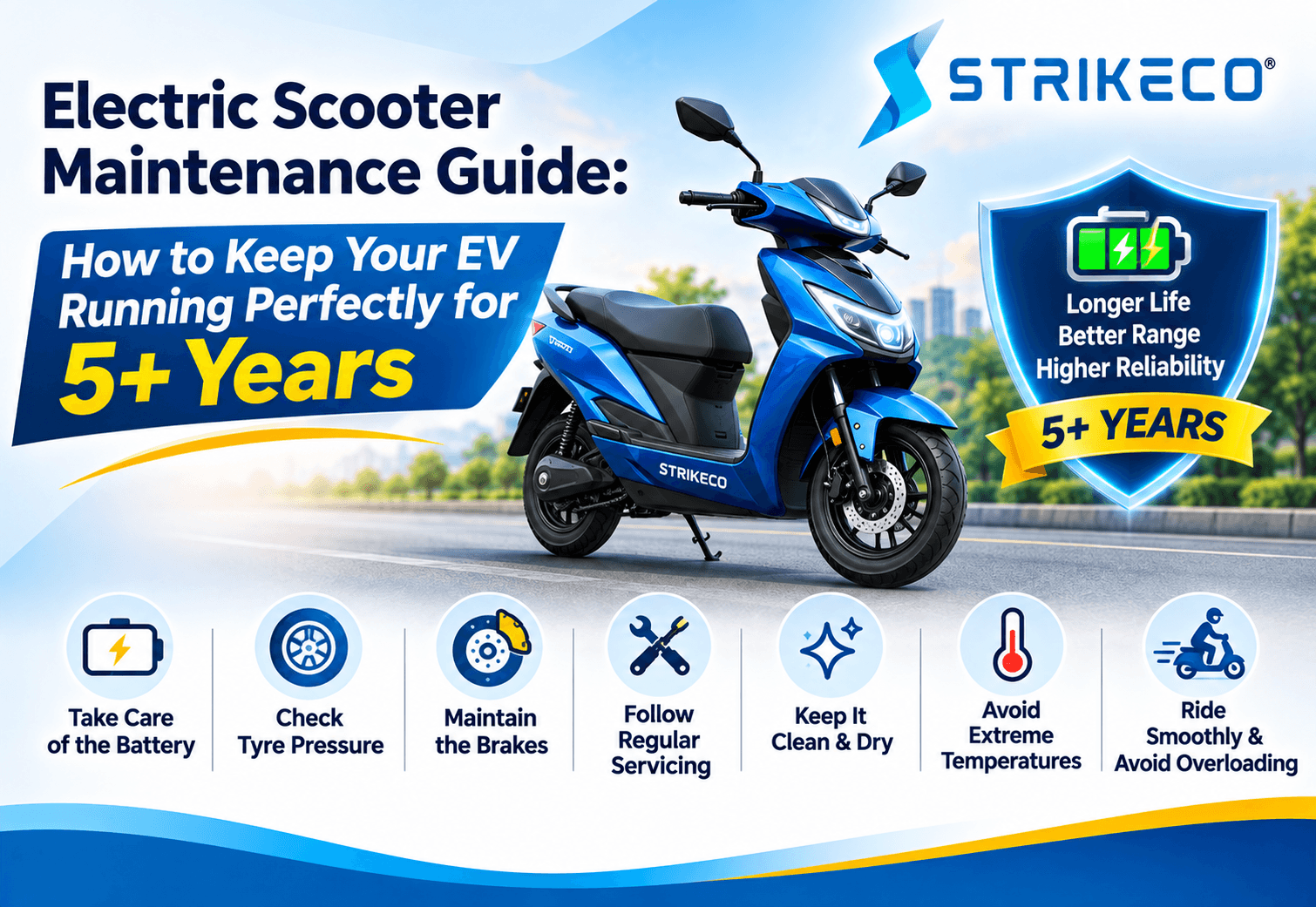
Electric scooters are becoming a popular choice for daily commuting because they are economical, convenient and require less routine maintenance than petrol-powered vehicles. However, owning an electric scooter does not mean you can ignore regular maintenance. Like any vehicle, an EV needs proper care to maintain its performance, safety and reliability.
One of the most important parts of an electric scooter is its battery. Charging habits, riding conditions, temperature and regular inspections can all influence battery performance over time. Other components, including tyres, brakes, suspension, electrical connections and the motor, also need attention.
With the right maintenance practices, you can help your electric scooter remain reliable for five years or longer. This guide explains how to maintain your EV, protect its battery and avoid common problems.
1. Take Proper Care of Your Electric Scooter Battery
The battery is one of the most important and expensive components of an electric scooter. Its condition directly affects the vehicle's range, charging performance and overall usability.
Whether your scooter uses a lithium-ion or lead-acid battery, following the manufacturer's charging and maintenance instructions is essential.
Follow the Recommended Charging Routine
Avoid developing charging habits that put unnecessary stress on the battery.
Some useful practices include:
Use the charger recommended by the scooter manufacturer.
Avoid using damaged or incompatible chargers.
Do not regularly leave the battery completely discharged.
Disconnect the charger according to the manufacturer's instructions.
Avoid charging a battery that is unusually hot or visibly damaged.
Follow the recommended charging limits for your specific battery type.
Lithium-ion batteries generally benefit from avoiding prolonged periods at very low or very high states of charge. However, the ideal charging routine depends on the battery chemistry and the manufacturer's battery management system.
Lead-acid batteries have different requirements. They should not be left in a discharged condition for extended periods because this can contribute to sulphation and permanent capacity loss.
Avoid Deep Discharging
Allowing an EV battery to become completely discharged frequently can affect its lifespan.
Try to recharge your scooter before the battery reaches an extremely low level. For lithium-ion batteries, occasional low-charge situations may be unavoidable, but repeatedly running the battery down to its cut-off point is not a good long-term habit.
For lead-acid batteries, avoiding deep discharge is particularly important.
Protect the Battery from Extreme Temperatures
High temperatures can accelerate battery ageing, while very low temperatures can temporarily reduce available performance.
To protect your battery:
Park your scooter in a shaded or covered area whenever possible.
Avoid leaving it under direct sunlight for long periods.
Allow an unusually hot battery to cool before charging, following manufacturer guidance.
Avoid storing the scooter in excessively hot or damp locations.
Good battery care is one of the most important steps towards maintaining consistent EV performance over several years.
2. Check Tyre Pressure Regularly
Tyres play an important role in an electric scooter's safety, efficiency and riding comfort.
Incorrect tyre pressure can increase rolling resistance, affect handling and reduce the distance your scooter can travel on a charge.
Check tyre pressure regularly using a reliable pressure gauge. Follow the pressure recommended by the scooter manufacturer rather than relying on a generic value.
Also inspect the tyres for:
Cuts and cracks.
Uneven tread wear.
Embedded stones or sharp objects.
Bulges or visible damage.
Unusual pressure loss.
If you notice uneven wear, get the tyres and wheel alignment inspected by a qualified technician.
Maintaining the correct tyre pressure can improve riding efficiency and help prevent avoidable tyre damage.
3. Inspect the Braking System
Electric scooters use braking systems that may include disc brakes, drum brakes or regenerative braking, depending on the model.
Since brakes are directly connected to rider safety, they should never be neglected.
Check for the following warning signs:
Unusual noises while braking.
Reduced braking response.
Excessive brake lever movement.
Vibrations during braking.
Visible wear on brake pads or discs.
Brake fluid leakage in hydraulic systems.
Brake pads, cables, discs and other components should be inspected and serviced according to the manufacturer's maintenance schedule.
Do not delay brake repairs if you notice a reduction in braking performance.
4. Keep the Electric Motor and Electrical Connections in Good Condition
The electric motor is responsible for converting electrical energy into mechanical movement. Although electric motors generally have fewer moving parts than petrol engines, they still require proper inspection.
Pay attention to:
Unusual sounds from the motor.
Excessive vibration.
Sudden changes in acceleration.
Unexpected power interruptions.
Loose or damaged electrical connections.
Warning lights or error messages on the dashboard.
Avoid attempting electrical repairs without the necessary technical knowledge. High-voltage components and battery connections should be handled by trained technicians.
If your scooter experiences repeated power cuts, overheating warnings or unusual motor behaviour, arrange a professional inspection.
5. Keep Your Electric Scooter Clean and Dry
Regular cleaning helps protect your scooter's body, electrical components and moving parts.
Dust, mud and road debris can accumulate around the wheels, suspension, brakes and other components. If left unattended, this buildup can contribute to corrosion or mechanical problems.
Follow these cleaning practices:
Use a soft cloth and suitable cleaning products.
Remove mud and dirt from the wheels and body.
Avoid directing high-pressure water at electrical connections.
Do not submerge the battery or electrical components.
Keep charging ports clean and dry.
Check for moisture around exposed connectors.
Electric scooters are designed to handle certain levels of water exposure, but this does not mean every model is waterproof. Always follow the manufacturer's water-resistance guidance.
After riding in heavy rain, inspect the scooter for visible moisture or damage and follow the recommended drying procedure.
6. Follow a Regular Maintenance Schedule
One of the easiest ways to keep an electric scooter in good condition is to follow a consistent maintenance schedule.
Even when your scooter appears to be working perfectly, periodic inspections can identify problems before they become expensive repairs.
Here is a general maintenance checklist. The exact frequency should follow your scooter manufacturer's service schedule.
Maintenance activity
Suggested frequency
Check tyre pressure
Weekly
Inspect tyres for damage
Weekly
Check brakes
Weekly
Clean the scooter
As required
Inspect lights and indicators
Weekly
Check charging cable and connector
Regularly
Inspect suspension and steering
During scheduled service
Check electrical connections
During scheduled service
Inspect battery condition
During scheduled service
Check motor and drivetrain
During scheduled service
Keep a record of servicing, repairs and battery-related issues. This makes it easier to identify recurring problems and understand how your scooter is performing over time.
7. Avoid Overloading Your Electric Scooter
Every electric scooter has a specified maximum load capacity. Carrying more weight than recommended can put additional stress on the motor, battery, suspension, tyres and braking system.
Overloading may also affect acceleration, braking distance and riding stability.
To protect your scooter:
Follow the manufacturer's maximum load limit.
Avoid carrying unnecessarily heavy luggage.
Distribute permitted loads properly.
Do not modify the vehicle to carry more weight than its design allows.
If you regularly ride with a passenger or carry heavy items, check that the scooter is designed for that usage.
8. Adopt Better Riding Habits
Your riding style can influence battery consumption and the wear of different scooter components.
Aggressive acceleration, sudden braking and continuous high-speed riding can increase energy consumption and place additional stress on the vehicle.
Consider these habits:
Accelerate smoothly instead of applying sudden throttle inputs.
Maintain a consistent speed where road conditions allow.
Avoid unnecessary hard braking.
Use regenerative braking where available and appropriate.
Avoid rough roads and potholes whenever possible.
Do not continuously operate the scooter beyond its recommended limits.
Smooth riding can help improve efficiency and reduce unnecessary wear on tyres, brakes and other components.
9. Pay Attention to Early Signs of Battery Problems
Battery performance can gradually change as the scooter gets older. However, a sudden drop in range or charging problems should not automatically be considered normal ageing.
Watch for these warning signs:
Reduced riding range: If your scooter travels significantly less distance than before under similar conditions, the battery or another vehicle component may need inspection.
Unusually long charging time: A change in charging behaviour may indicate a charger, battery or electrical issue.
Sudden battery percentage drops: Inconsistent battery readings can indicate a battery management or battery condition problem.
Unexpected power cuts: Sudden shutdowns or power interruptions should be investigated.
Excessive heating: Unusual battery or charger heating requires immediate attention. Stop charging or using the scooter if it appears unsafe and contact an authorised service centre.
Do not open the battery pack or attempt to repair internal battery components yourself.
10. Maintain Your Electric Scooter Properly During Long Periods of Non-Usage
If you are not planning to use your scooter for several weeks, proper storage becomes important.
The correct storage procedure depends on the battery chemistry.
For lithium-ion batteries:
Follow the manufacturer's recommended storage charge level.
Store the scooter in a cool, dry and ventilated location.
Check the battery periodically as recommended.
Avoid leaving the battery fully discharged for extended periods.
For lead-acid batteries:
Store the battery fully charged, following manufacturer instructions.
Recharge periodically as recommended.
Avoid leaving it discharged for long periods.
Check for corrosion, leakage or visible damage.
If your scooter has a removable battery, follow the manufacturer's instructions for removing and storing it safely.
11. Common Electric Scooter Maintenance Mistakes to Avoid
Even regular scooter users can develop habits that gradually affect vehicle performance.
Avoid these common mistakes:
Using an incompatible charger: The wrong charger can create charging and safety problems.
Ignoring tyre pressure: Incorrect pressure affects handling, efficiency and tyre life.
Skipping scheduled servicing: Small mechanical or electrical problems may become expensive repairs.
Ignoring unusual sounds: New noises or vibrations should be investigated.
Exposing electrical components to water: Improper washing can damage sensitive components.
Overloading the scooter: Excessive weight puts additional stress on the vehicle.
Ignoring battery warnings: Dashboard alerts and unusual battery behaviour should not be overlooked.
Consistent maintenance is usually more effective than waiting until a major problem develops.
12. Can an Electric Scooter Last More Than Five Years?
Yes, an electric scooter can remain in service for more than five years, provided it is built with suitable components and maintained properly. However, its actual lifespan depends on several factors.
These include:
Battery chemistry and manufacturing quality.
Battery charging and storage habits.
Daily distance travelled.
Road and weather conditions.
Riding style and vehicle load.
Quality of servicing and replacement parts.
Availability of authorised repair support.
It is also important to understand that the battery may not retain its original capacity throughout the scooter's life. Battery performance gradually changes with age, usage and environmental conditions.
A scooter that has been maintained properly may continue to operate even if its original battery needs replacement.
Therefore, maintaining an electric scooter for five years or longer is not just about protecting the battery. It requires attention to the entire vehicle, including its tyres, brakes, suspension, motor and electrical system.
Frequently Asked Questions
1. How often should an electric scooter be serviced?
Follow the service intervals recommended by the scooter manufacturer. Regular checks of tyres, brakes, lights and charging components should also be part of your routine.
2. How can I increase my electric scooter battery life?
Use the recommended charger, avoid repeated deep discharging, protect the battery from extreme temperatures and follow the correct charging and storage instructions for your battery type.
3. Is it safe to charge an electric scooter every day?
Daily charging can be suitable depending on your usage and battery design. Follow the manufacturer's charging instructions and avoid using damaged charging equipment.
4. Does riding at high speed reduce EV battery range?
Generally, higher speeds increase energy consumption because aerodynamic resistance rises with speed. This can reduce the distance available from a single charge.
5. Should I charge my electric scooter immediately after riding?
If the battery is unusually hot after riding, allow it to cool according to the manufacturer's instructions before charging. Otherwise, follow the recommended charging procedure for your model.
6. Can an electric scooter last for 10 years?
It is possible for some electric scooters to remain in service for ten years or longer, but this depends on the vehicle's design, maintenance, battery condition, component replacement and availability of spare parts. It should not be treated as a guaranteed lifespan.
Conclusion
Maintaining an electric scooter for five years or longer requires consistent attention to its battery, tyres, brakes, motor and electrical components. Good charging habits, regular servicing, safe riding practices and proper storage can help maintain performance and reduce avoidable repairs.
Remember that battery maintenance is particularly important because the battery has a major influence on an electric scooter's range and usability. Choosing a reliable EV with a suitable battery system and following the manufacturer's maintenance recommendations can make a significant difference over the years.
A little preventive care today can help keep your electric scooter dependable for many journeys ahead.