Electric scooter range is one of the first things Indian buyers want to know before making a purchase. It affects daily commute planning, charging habits, and whether the scooter can handle real-world traffic, weather, and road conditions without running out of power.
The short answer is that the distance an electric scooter can travel on one charge depends on the battery size, rider weight, speed, terrain, tyre pressure, traffic, and riding mode. In India, real-world range is often lower than the claimed range because roads, stop-and-go traffic, and heat all affect battery efficiency.
What scooter range actually means
Range is the maximum distance a scooter can travel before the battery is fully drained. Manufacturers usually quote ideal test conditions, which are not always the same as everyday riding. That means the real distance you get may vary depending on how and where you ride.
For Indian riders, this is especially important because city traffic, frequent braking, and uneven roads can reduce efficiency. So instead of relying only on brochure numbers, it helps to understand what affects range in real use.
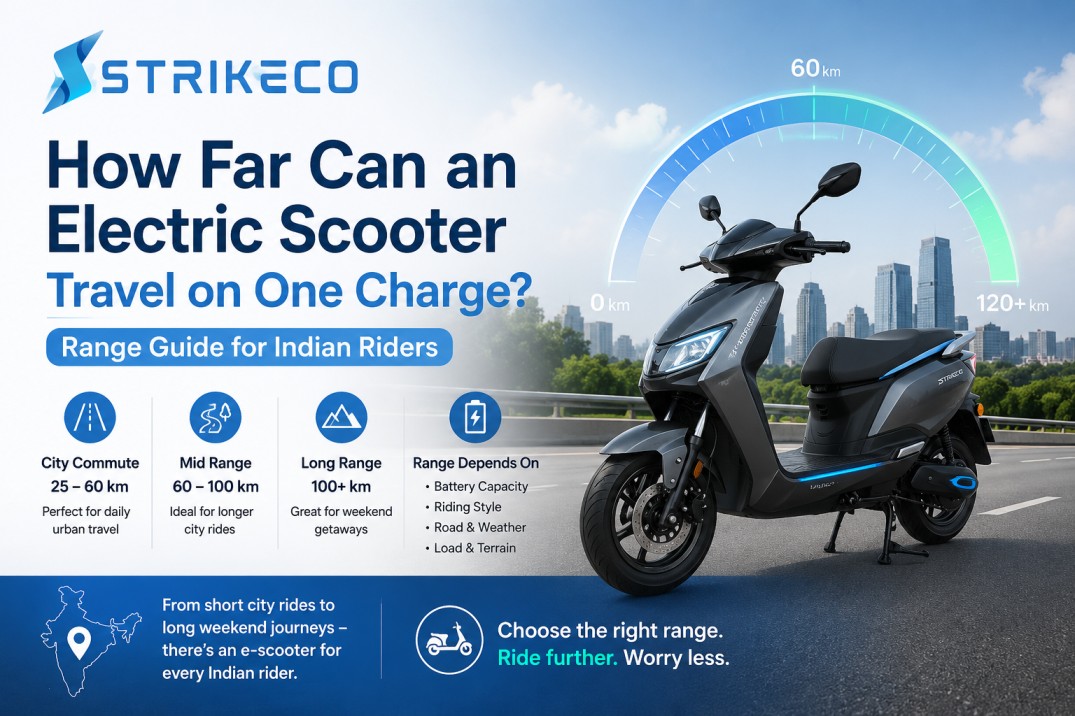
Typical range categories
Electric scooters in India usually fall into a few broad range categories:
Low range: around 40 to 70 km per charge.
Medium range: around 70 to 120 km per charge.
High range: around 120 km and above per charge.
These are general estimates, not fixed figures. A scooter that claims 100 km may deliver less in traffic-heavy conditions, while a well-maintained scooter ridden gently may come close to the quoted number.
Factors that affect range
Battery capacity
The larger the battery, the more energy it stores. A scooter with a higher-capacity battery will generally travel farther on one charge. Battery capacity is usually measured in kilowatt-hours, and this is one of the biggest indicators of range potential.
Riding speed
Higher speeds use more energy. If you ride at a steady moderate speed, you’ll usually get better range than if you accelerate hard or keep riding at top speed.
Traffic conditions
Stop-and-go traffic reduces range because the scooter is constantly accelerating and braking. Smooth riding in lighter traffic usually gives better results.
Rider weight and load
Heavier loads require more power. If you ride with a pillion, carry luggage, or frequently ride uphill, the range will reduce.
Terrain and road quality
Flat roads help preserve battery life, while steep roads and rough surfaces can drain it faster. In many Indian cities, road conditions can make a noticeable difference to real-world performance.
Tyre pressure
Underinflated tyres increase rolling resistance, which means the motor has to work harder. Keeping tyres properly inflated can improve efficiency and extend range.
Weather and temperature
Extreme heat or cold can affect battery performance. In India, high temperatures may influence battery efficiency and long-term health if the scooter is exposed to harsh conditions regularly.
Riding mode
Many scooters offer eco, normal, and sport modes. Eco mode usually gives the best range, while sport mode delivers faster acceleration but drains the battery quicker.
Claimed range vs real-world range
This is where many buyers get confused. The claimed range is often measured under controlled test conditions with light load, steady speed, and ideal temperatures. Real-world range is what you actually get on the road.
In India, real-world range is often 15% to 30% lower than the claimed number, depending on conditions. If a scooter claims 100 km, many riders may realistically see something closer to 70 to 85 km in daily use.
How to estimate your daily need
Before choosing a scooter, calculate your daily travel distance. If you travel 20 km per day, a scooter with a real-world range of 80 km is usually sufficient. If your daily commute is longer or you cannot charge every day, you may need a scooter with a bigger battery and higher range.
It is always wise to keep some buffer. A scooter should ideally offer more range than your daily need so you do not have to charge too often or worry about battery drain.
Best range for different users
City commuters
If you mostly ride short distances in the city, a scooter with 60 to 90 km of real-world range may be enough.
Office goers
For daily office commutes of 20 to 40 km, a scooter with 80 to 120 km real-world range is more practical.
Delivery riders
Delivery riders usually need higher range because they ride for longer hours. In this case, a scooter with strong battery performance and fast charging support is more suitable.
Long-distance users
If you travel across suburbs or make frequent long trips, look for scooters with higher-capacity batteries and dependable real-world range above 100 km.
Charging time also matters
Range is not the only thing to check. Charging time matters too, especially if you ride daily. A scooter with good range but very long charging time may not be convenient if you do not have easy access to charging at home or work.
Fast charging can help, but it should be balanced with battery health. Some riders prefer a slightly lower range if the scooter charges faster and fits their routine better.
How to improve scooter range
You can extend range by riding smartly and maintaining the scooter well.
Useful habits include:
Keep tyre pressure at the recommended level.
Avoid sudden acceleration and hard braking.
Use eco mode when possible.
Reduce unnecessary load.
Service the scooter regularly.
Charge the battery properly and avoid extreme discharge.
Ride at moderate speeds when possible.
These simple habits can improve efficiency and make each charge last longer.
Which range is right for you
The right range depends on how you use the scooter. If your daily riding is limited and charging is easy, a lower-range scooter may be enough. If you need longer city travel, avoid range anxiety by choosing a model with more battery capacity.
Indian riders should think in terms of real-world range, not just showroom figures. That is the best way to avoid disappointment after purchase.
An electric scooter can travel anywhere from 40 km to more than 120 km on one charge, depending on the model and riding conditions. For Indian riders, real-world range matters more than claimed range because traffic, heat, road conditions, and riding style all influence performance.
If you understand your daily commute and compare it with realistic range expectations, you can choose a scooter that fits your lifestyle without constant charging worries.
FAQs
How far can an electric scooter go on one charge in India?
Most electric scooters in India offer real-world ranges between 40 km and 120 km, depending on battery size and riding conditions.
Why is real-world range lower than claimed range?
Because claimed range is usually tested under ideal conditions, while real riding includes traffic, stops, load, and road variation.
Does speed affect electric scooter range?
Yes. Higher speed usually reduces range because the motor uses more energy.
Can I increase my scooter’s range?
Yes. Proper tyre pressure, smooth riding, eco mode, and regular maintenance can all help improve range.
What range should I choose for daily commuting?
Choose a scooter with a real-world range that is at least 20 to 30 km more than your daily round trip for a comfortable buffer.